
As HECK! expands capacity, upgrades systems, and grows sales, it prepares for its next phase
HECK! plans to double its factory footprint, roll out a business-wide ERP platform, and boost capacity to support up to £100 million in turnover. James Ashford, Head of Procurement, helps drive this evolution. He oversees procurement, supply chain, stock control, master data, technology systems, and operational performance across the business.
With HECK! continuing to expand, the challenge is not just keeping up with demand. James and the team as a whole are building the structure that lets the business scale without losing control of operations, data, or decision-making.
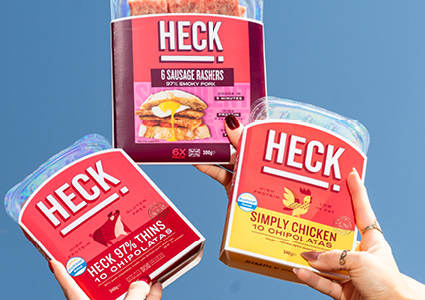
That pressure has grown as HECK! has picked up the pace. The North Yorkshire manufacturer, famous for its gluten-free sausages, burgers and mince, expects turnover between £41 million and £42 million this year, up from £32 million last year.
James credits several factors working together for this growth. “It is quite varied. We are increasing distribution with existing retail partners and bringing on new ones. Some new foodservice businesses have joined us, too. People are looking for low-fat, high-protein products, especially right now, and that is what we have always offered. People are staying in more, so we are picking up sales because of that.”
Market conditions have helped, but growth really comes from a steady focus on innovation. Instead of moving away from its core categories, HECK! finds new ways to offer consumers more formats and more occasions for products they already love. Take the pork and chicken rashers, for example. They have become a staple of the range in less than two years, as James points out: “They are our take on bacon, but as a sausage. Thin strips, ready in about five minutes; super easy, super convenient, high in protein, and they are selling really well.”
James connects product development, operations, and demand planning, reflecting his broad experience in procurement, supply chain, operations, and business systems. His background shapes how he makes decisions across the business. “Procurement cannot operate in isolation. Sourcing affects production. Production affects inventory. Inventory affects service, capacity, and growth.”
That systems-focused mindset is clear in one of HECK!’s biggest investments: expanding its manufacturing facility in Bedale. The site opened in 2017, when the business was much smaller. Since then, production has grown from a few lines to six, bringing much more pressure on production space. “When we built the initial site, we thought we had loads of room. But now, we have definitely outgrown the floor space. Our aim is to improve factory flow so we can boost production capacity and overall efficiency,” James adds.
The £2.5 million expansion project will reorganize the site around current and future production requirements, creating a more effective flow through manufacturing, storage, and dispatch operations.
For James, this investment is about giving HECK! room to grow. “Right now, we are at about £42 million in turnover. The new factory capacity will take us somewhere between £75 million and £100 million. That means we will be ready for the next stage of growth,” he adds.
Data-driven decision making
Alongside physical expansion, HECK! is undertaking a digital transformation that reaches across the organization. For a company that has grown rapidly, consolidation has become a priority. Systems, spreadsheets, and processes built at different points now need to come together into a single structure.
HECK! is implementing a new ERP platform through FoodTec based on Microsoft Dynamics 365 Business Central. The project requires teams across the business to review processes, challenge existing ways of working, and create consistency in how information is managed.
As the company grows, James makes sure the company’s systems evolve, too. The new ERP platform will connect data across the business, creating more visibility and consistency as volumes increase. “Because we are growing so fast, we have a lot of legacy systems. There is a legacy warehouse management system, and a lot of people working off spreadsheets, one Excel sheet layered on another. Ultimately, we want to be singing from the same hymn sheet,” he points out.

Food manufacturers across the UK are grappling with similar pressures. Rapid growth often outpaces the systems built to support it, leaving businesses to run on a patchwork of spreadsheets, legacy software, and manual workarounds. For a sector where margins are tight and traceability requirements are strict, that patchwork becomes a liability rather than a workaround. Consolidating onto a single platform is not just an IT upgrade; it is a foundational step that determines how well a business can scale, report accurately, and respond to retailer and regulatory demands as volumes climb.
James views the ERP project as much more than operational consistency. Creating a single source of reliable data builds the foundation for future business capabilities, like predictive analytics, faster decision-making, and better customer service. “We cannot really take advantage of those opportunities until our own data is organized and structured,” James observes. The same idea drives HECK!’s approach to automation. Automation has become a top priority as the team navigates a tight labor market. Capacity planning and workforce strategy must go hand in hand with investment decisions.
HECK! now runs production seven days a week to meet customer demand. At the same time, the team is looking at automation projects to boost output and build resilience. “Like everybody, we are dealing with labor shortages and struggling to find skilled workers. Much of our focus goes into making sure we invest in automation and operational capacity.”
Operational change and growth accompanied another landmark for HECK! In 2026, the company bought back the equity stake held by Panoramic Growth Equity, returning HECK! to full family ownership after more than a decade. That move ended an 11-year partnership with the private equity firm. “Panoramic was our equity partner for 11 years, and they have been fantastic. They played a key role in helping us grow from those early stages.” Leadership felt the business was in a strong enough position to bring HECK! back to full family ownership. This change has not altered the culture that shaped the business from day one. Instead, it gives leadership the freedom to align long-term investments with big ambitions.
With the ownership transition complete and major investments underway, attention now turns to the next phase of growth. James concludes, “The focus is no longer on establishing the business, but on creating the capacity, systems, and structure needed to support what comes next.”