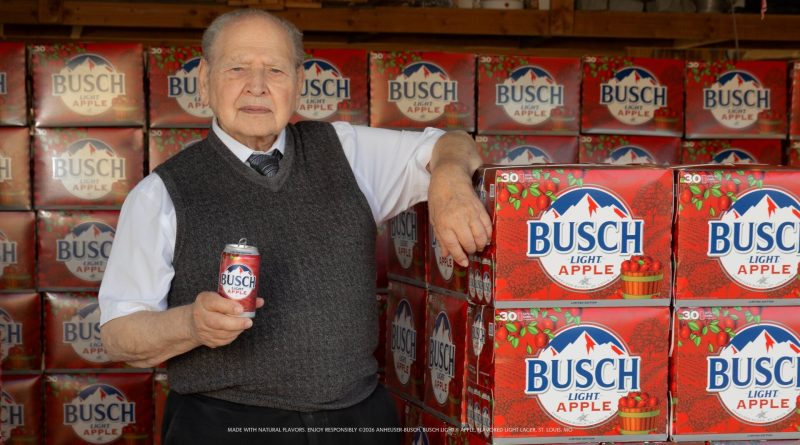
Busch Light Apple returns as demand reshapes beer strategy
Subscribe to our free newsletter today to keep up to date with the latest food industry news.
Busch Light Apple is back on shelves in 2026, marking another chapter in what has become a repeatable product cycle rather than a one-off seasonal experiment. Originally introduced in 2020, the apple-flavored lager was never positioned as a permanent addition to Anheuser-Busch’s portfolio. Instead, it has evolved into a case study in how brands respond to consumer demand in near real time.
The product’s reappearance is tied closely to sustained pressure from its audience. Over the past several years, social media has served as both a feedback loop and an informal demand signal, with consumers repeatedly calling for its return. That demand has translated into measurable performance. In previous releases, Busch Light Apple moved more than 1.2 million cases within its first month, an unusually strong showing for a flavored extension of a legacy light beer.
The brand has also developed its own identity within the broader Busch portfolio. Known informally as “Bapple,” the product has built a following that operates more like a niche community than a traditional mass-market audience. That distinction matters. It suggests that even large-scale brewers are now able to cultivate sub-brands with distinct consumer bases, rather than relying solely on broad, undifferentiated appeal.
This cycle of removal and return has effectively turned Busch Light Apple into a recurring event. Each re-release is framed as limited, which reinforces urgency while preserving the perception of scarcity. Over time, this approach has shifted the product from novelty to expectation, with consumers anticipating its return rather than discovering it for the first time.
Why limited-time releases are outperforming permanent SKUs in beer
The success of Busch Light Apple highlights a broader shift in how beverage companies think about product lifecycles. In categories where growth has slowed, limited-time offerings are increasingly used to create momentum without the risk associated with permanent launches.
Scarcity plays a central role in this strategy. By positioning products as temporary, brands encourage immediate purchase behavior while avoiding long-term commitments to production and distribution. This model also allows companies to test variations without diluting their core lineup. If demand fades, the product can simply disappear without reputational damage.
The data behind Busch Light Apple supports this approach. A significant share of its buyers during previous releases were new to the beer category, indicating that flavored extensions can serve as entry points for consumers who might otherwise avoid traditional lagers. That dynamic is particularly important as younger demographics show more fragmented drinking preferences and a willingness to explore alternatives such as ready-to-drink cocktails and hard seltzers.
For Anheuser-Busch, which controls a substantial portion of the US beer market, the ability to attract new drinkers without repositioning its flagship brands is a strategic advantage. Limited releases like Busch Light Apple act as low-risk experiments that can generate both volume and insight.
What flavored beer reveals about changing consumer preferences
The continued demand for Busch Light Apple reflects a broader evolution in taste. Flavored beers, once considered peripheral, are now part of a wider movement toward hybrid beverages that blur traditional category lines.
Consumers are showing greater openness to products that combine familiar formats with new flavor profiles. Apple, in particular, occupies an interesting middle ground between beer and cider, making it accessible to a wider audience. This kind of crossover appeal lowers the barrier to entry for consumers who may not identify as regular beer drinkers.
The trend also aligns with a shift toward more casual, occasion-based consumption. Rather than adhering to a single preferred beverage type, many consumers are choosing drinks based on context, season, or social setting. Limited releases fit naturally into this pattern, offering variety without requiring long-term commitment.
At the same time, flavored innovations provide legacy brands with a way to remain relevant without abandoning their core identity. Busch Light Apple retains the branding and positioning of Busch Light while introducing a variation that feels distinct enough to generate interest.
The strategic role of nostalgia and community in product design
Beyond flavor, Busch Light Apple’s success is tied to how it engages its audience. The product’s repeated returns are framed as responses to consumer demand, reinforcing a sense of participation among its fan base. This dynamic transforms customers from passive buyers into active contributors to the brand’s direction.
Nostalgia also plays a role. Each re-release taps into previous experiences, whether that is a past summer or a memorable social moment. By reintroducing the product rather than keeping it continuously available, the brand preserves that sense of occasion.
From a strategic perspective, this approach offers a balance between innovation and stability. Instead of launching entirely new products, companies can recycle proven concepts in ways that feel fresh. This reduces development risk while maintaining engagement.
For the beer industry, which continues to face pressure from shifting consumption habits, the implications are clear. Growth is less likely to come from large-scale permanent launches and more likely to emerge from agile, demand-driven cycles. Busch Light Apple is not just a returning product. It is an example of how legacy brands are adapting to a market where consumer voice, speed, and flexibility now define success.
Sources:
USA Today
Image credits:
Anheuser-Busch