
Demos’ Brands builds on a legacy of hospitality while remaining grounded in purpose and people
For almost 40 years, Demos’ Brands (Demos’) has built its reputation on something refreshingly simple: real food, generous portions, and genuine, God-glorifying hospitality. Founded by Jim and Doris Demos in 1989, the restaurant grew from a shared belief that great hospitality is about more than what’s on the plate, but about serving people well, creating a place where everyone feels at home, and making a positive impact. Today, under the leadership of Peter Demos, a fourth-generation restaurateur, that commitment to hospitality continues to shape everything from the guest experience to the company culture – proving that doing business with purpose is just as important as serving a great meal.
“Demos’ Restaurant was started by my parents in 1989. My father wanted to have something of his own – something where he didn’t have partners or investors and didn’t have to answer to anybody. It was something he envisioned as a business he could eventually retire into,” Peter begins, reflecting on Demos’ journey thus far.
“The restaurant business has been part of my family for generations. I initially left the industry to go into law, but I eventually returned to the restaurant business in 1999. I wanted to be a lawyer because I wanted to help people, but I eventually realized that I could make a greater impact on people’s lives through restaurants, both with customers and employees. I then took over the operations in 2001 and bought the business from my father in 2009. We’re now coming up on our 37th anniversary, which is remarkable.”
Intentional service
From steak and seafood to pasta and chicken, Demos’ menu is eclectic, but there’s one thing you won’t find: a fryer. The same intentionality that shapes what Demos’ puts on the plate, though, also shapes how the company serves its people. That commitment to serving others became even more meaningful when Demos’ redefined its purpose around caring for both customers and employees, transforming not just its approach to hospitality, but its culture from the inside out.
“About ten years ago, we changed our purpose because that was when I had a profound change in my faith. We changed our purpose to ’glorify God by serving others’, which means serving and caring for both our customers and our employees. Prior to that, we took care of our employees in much the same way we would take care of a piece of equipment. We did good things for them and treated them well; otherwise, we would not have two employees to celebrate 30 years with us this month, but truthfully, there was a more selfish reason behind it.
“When that changed, we began to see people the way God sees them, and that fundamentally changed our culture,” Peter reveals. “At that point, we also developed our values. Having those foundational values is important for every company. When you find yourself in a moment of tension or uncertainty, if you don’t have those values to fall back on, you react and make judgments based on what everyone else is telling you to do.
“We also have chaplains that work for us,” he adds. “Our chaplain is available 24 hours a day, seven days a week. If any of our employees are experiencing a crisis, the chaplain is there to help and counsel them.”
With a clear set of values guiding decisions and a commitment to helping employees grow, the company is exploring new ways to better understand people’s strengths, identify areas for development, and provide the support they need to thrive. One example is the ESAT, a new program designed to do just that.
“The ESAT is a relatively new program developed by a clinical psychiatrist and certified mediator,” Peter elaborates. “The first part of the program is a screening process. Candidates complete an assessment that looks at different traits, such as emotional intelligence, communication, problem-solving, critical thinking, integrity, and self-awareness. We can then look at each candidate and understand where their strengths and weaknesses are. We use that to complement our interviews, rather than relying on it to make hiring decisions. The second part of the program is centered on training, with online videos and modules designed to help people improve in the areas where they may be weaker. We’re excited to be part of the pilot program and to see how it develops.”
Growth and purpose
As Demos’ continues to invest in its people, the company is also looking ahead to its next chapter of growth and development. That means finding new ways to extend its people-first approach beyond its traditional restaurant footprint – a strategy reflected in its recent partnership with Middle Tennessee State University.
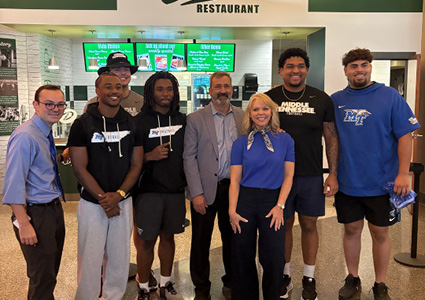
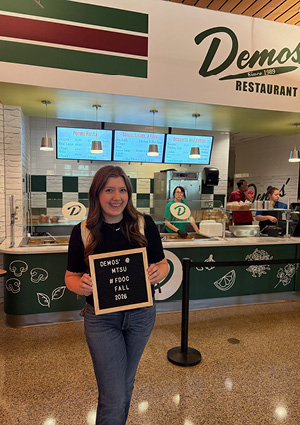
“We now have a contract with the Middle Tennessee State University to lease space in their Student Union Building, as well as a separate contract to provide catering services,” Peter details. “For our restaurant on campus, we built the menu around our fastest menu items. What’s amazing is that, on average, only 43 seconds pass between the time a student places an order and the time they receive their food. If we can replicate the concept at other universities, we’d like to explore that opportunity.”
Nearly four decades after Jim and Doris Demos opened their first restaurant, the company they built continues to evolve without losing sight of what made it special in the first place. From investing in its people and strengthening its culture to exploring new opportunities beyond the traditional restaurant model, Demos’ is demonstrating that growth and purpose can go hand in hand. Under Peter Demos’ leadership, the next chapter is taking shape with the same commitment to serving others that has defined the brand from the beginning.
“A lot of our employees have been with us for a long time, and some are now reaching retirement age, so our number one focus right now is hiring and training the next generation,” Peter affirms, looking to the years ahead. “The second priority is our longer-term growth strategy. In three to five years, we’re hoping to begin expanding with a scaled-down version of the restaurant – both in terms of the size of the menu and the size of the building. Independent restaurant chains are increasingly being squeezed from both sides. We’re now figuring out how we can expand at a lower cost while leveraging the reputation and experience we’ve built over the years.”