Discover Food Team International’s clever strategy for sourcing food from the other side of the world
Retailers, wholesalers and manufacturers across the UK and Europe turn to Food Team International (Food Team) when they need a reliable, far-reaching sourcing partner. With a portfolio spanning canned, ambient, chilled, frozen, dried, beverage and lifestyle products, the company works with manufacturers around the world to bring high-quality ingredients, food and beverage products to market. Mark Roscoe, Managing Director, provides a comprehensive overview of Food Team’s operations.
“Prior to joining Food Team in 2005, I worked for another importer and distributor, and Food Team was one of our suppliers. Half Dutch and half Chinese owned, Food Team had an impressive system for supplying foodstuffs from China, Vietnam and South America. In China, the company had people on the ground in various hubs monitoring quality and consistency. When I joined as a young trader, what struck me was that the company was genuinely doing what it said it was doing, it was not just a marketing tactic. After completing my MBA, one of the first decisions I made was to start my own company and bring Food Team to the UK,” he opens.
Mark’s model was built around alternative sourcing: if a buyer was purchasing a product from one country in Europe, Food Team UK would offer them the same product to the same specification from a different origin in Asia, Africa, Europe or South America. “We would always advise buyers not to move everything to us, perhaps just 20 percent, and continue to buy from their existing suppliers. That way, if a geographical or supply issue arose, they had a plan B already approved and ready to go,” he adds.
That strategy worked very well for Food Team, and the business grew steadily through to the Sydney Olympic Games. But after that, a series of food scares began to reveal cracks in the model. The monitoring and tracing systems Food Team had put in place were truly ahead of their time. Some of the biggest players in Europe were sourcing from the company, and Food Team was even featured in European magazines and documentaries for the way it operated. While this increased trust in potential and existing customers, Food Team had unintentionally handed competitors a roadmap by showcasing its sourcing methods so openly, with some of them opening their own offices abroad. Around 2008, the owner of Food Team at the time responded by purchasing a factory in the Netherlands and beginning to grow and process some of the products the business had previously sourced entirely from South America, Europe and China. “That shift worked well for us, as we could now offer the alternative sourcing model across China, Vietnam and South America while also having our own production capability in the Netherlands. Fast forward to just before the pandemic, and I bought the UK and Danish operations of the business. We have since opened offices in the Netherlands and Germany as well,” Mark reveals.
Strategic supplier network
With Danish, German and British operations now running simultaneously, Food Team has found real synergies in the way its branches complement each other, though Brexit has added complexity to everything the company brings into the UK. In its early days, Food Team was a frozen food specialist, supplying items like frozen sliced peppers for pizzas and asparagus for soup. When Brexit happened, the priority shifted from specialism to reliability, as getting customers the right product at the right time became more vital. Food Team quickly recognized that in the UK market, it could expand its offering to include frozen vegetables, frozen fruits, canned goods, dried goods, and whatever else customers needed sourced and delivered without friction.
“The model in the UK became simple: as long as you are a reliable supplier and you get product to customers on time, it works. Meanwhile, in mainland Europe, buyers want specialists, because they already have frictionless trade. It is easy for a large German buyer to import a container from China directly, so if they choose to use an importer, it is because something about the process is complicated or they want to trial something new. Our European teams reflect that model, with Germany focusing exclusively on canned goods like peaches, sauerkraut and gherkins, while Denmark works solely in frozen food. That focus means our German buyers would never think to put us in a frozen category, and our Danish clients would never associate us with canned goods. The operational model differs too. In Europe, almost everything moves in full loads and we hold no stock at all, whereas in the UK, we hold around eight weeks’ worth of stock, which can represent up to £8 million of inventory at any one time,” Mark emphasizes.
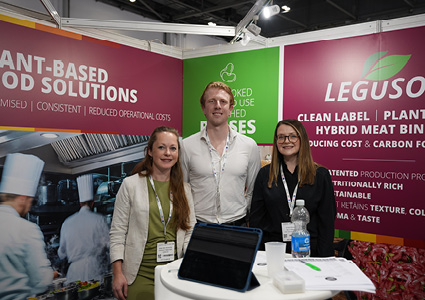
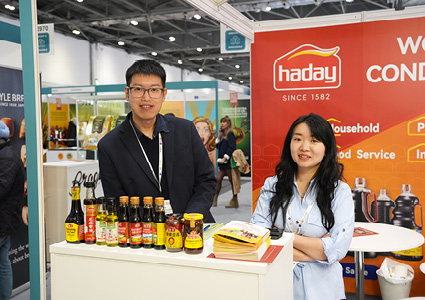
That breadth of offering and supplier network was on full display a few weeks ago when Food Team, including Mark himself, attended the International Food and Drink Event 2026, to showcase four of its trusted UK suppliers. “Our team was effectively learning from our suppliers while also helping answer their questions about the differences between the UK market and their home markets,” he informs. One of the standout products on show was Legusol, developed by Food Team’s Dutch supplier Coroos, which has invested €15 million in a production line aimed at helping food businesses reduce their meat costs without compromising on taste or quality. Made from 100 percent natural ingredients including chickpeas, haricot beans, rice flour and beetroot fiber, Legusol is processed in a way that when minced together with meat, it binds to the proteins and absorbs the juices and fats during cooking. In other words, the meat absorbs the product and Legusol homogenizes with the meat in both color and flavor.
Food Team has now introduced Legusol to many of its customers, and feedback from chefs and clients alike consistently indicates that using between ten and 20 percent Legusol alongside minced meat actually improves the flavor. “The reason for that is that in factory-prepared dishes like lasagna, much of the meat’s natural juices, fats and flavor are lost during processing, whereas Legusol retains them,” Mark enlightens. Alongside Coroos, Food Team’s other suppliers at IFE showcased a unique range of innovations: a frozen avocado product that stays green after defrosting, a range of frozen ready-to-eat cooked pastas, and a specialist sauce supplier, all presenting genuine newness and effective innovation to the UK market. Their knowledge and expertise of the manufacturing and food service sectors allow them to identify value chain optimization opportunities, helping their customers find efficiencies outside of the traditional commodity trading approach.
Throughout its history, Food Team has proven that knowing where to source and what to stock is what makes a successful food supply business.