How Caterfood Buying Group unifies seven independent wholesalers with unique business plans and a shared vision
Built on a philosophy that champions independence over uniformity, Caterfood Buying Group (CFBG) has redefined what a modern buying group can look like. With standout businesses such as Caterfood (SW) at its core, the group combines regional expertise, diverse product innovation, and a collaborative spirit to deliver a truly differentiated offering across England and Wales.
When CFBG was backed by Bidcorp UK in 2012, it began successfully initiating itself as a separate and unique buying group across England and Wales, bringing together a collection of independent foodservice suppliers and offering an extensive product range, industry expertise, and a wide geographical reach. Currently owning a series of independently run and highly successful member businesses, CFBG is committed to maintaining its individual customer bases along with heritage and independence.

With member businesses comprising South Lincs Foodservice, Caterfood (SW), Nicol Hughes, Elite Fine Foods, Harvest, Thomas Ridley Foodservice and Turner Price, the group is passionate about acquiring and supporting independent wholesalers over national giants.
CFBG’s official formation in 2019 corresponded with Managing Director Philip (Phil) Atyeo taking up his role at the company. He joins Food Chain to tell us more about product strategy, collaboration between businesses and sharing a collective vision. “Twelve years ago, Bidfood, who are owned by Bidcorp UK, purchased the foodservice supplier South Lincs,” Phil starts. “After a couple of acquisitions that hadn’t been overly successful, they decided to do it differently and keep it as a standalone business. We were able to secure the customer base without the turmoil and change of rebranding it. There was an understanding that some customers want to work with regionals as opposed to national companies.”
Collective culture
Phil goes on to explain one of the challenges when developing buying groups: “When you bring people into the fold, a buying group can sever ties, because they’re worried about information sharing. That leaves these businesses disadvantaged as they don’t want to be part of the company, but then they’re not allowed to be part of buying groups either.” Subsequently, when it launched CFBG had the goal of replicating a level of freedom for its member businesses that they had in the independent world.
Product strategy also differs significantly from the national model. “When I was working for national companies, they implemented the 80/20 rule,” Phil continues. “Here, 20 percent of your products give you 80 percent of the volume. At CFBG, we’re more interested in exploring products that are less mainstream and therefore keep our customers different in the marketplace.”
Furthermore, CFBG’s customer base spans sectors. “We serve anybody who provides meals in an out-of-home setting,” Phil states. “Our last two acquisitions – Thomas Ridley and Turner Price – were more education and care-sector based, while our Caterfood business in the Southwest very much serves leisure and seaside establishments. Each business has its own pillar of strength and across the seven, we’ve got it all covered.”
When integrating businesses, the group’s priorities are lessening disruption by adhering to templates for consistency, keeping change to a minimum, and embedding its culture centered on purpose. “We work extremely hard to accomplish our collaborative vision, which is to unite our communities through exceptional food,” highlights Phil. “We want all our members to understand that what they do is more important than just delivering boxes. This could be someone’s wedding anniversary, birthday or another celebration. Everybody is equal and understands the importance of our work; the people who courier the boxes are just as important as the people who sell them. That’s probably one of the biggest differences we find through acquisitions. We’re very equitable.”
Culinary connections
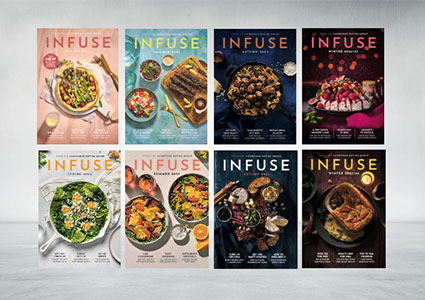
These cultural values led to Phil envisioning a new quarterly magazine, named Infuse, which aims to educate and entertain while also being an innovative marketing tool. Drafting in Head of Brand, Design, and Marketing, Morgan Apel-Leonard, who created Infuse, the magazine is designed, written and produced specifically for the professional chef and commercial caterer. “I wanted to provide a magazine that people would enjoy reading and give them something of value, rather than just telling them how much money they can save on a tin of beans, for example. We don’t want to sell aggressively to our readership – we want to have a conversation.” The magazine has evolved into a vital touchpoint between CFBG and the professional catering community, delivered exclusively to member customers. Each issue is crafted to foster support, connect industry experts and offer solutions that extend beyond conventional culinary content, featuring seasonal menu inspiration and highlighting sustainable sourcing practices.
Complementing its own-brand strategy, CFBG developed the Caterfood Collection – a comprehensive range of private-label products spanning three quality tiers: basic, select, and premium. This tiered approach allows members to serve diverse customer segments, from budget-conscious care homes requiring value without sacrificing nutrition to high-end restaurants demanding premium ingredients at competitive margins.
CFBG is also renowned for its influential ‘Meet the Buyer’ events. These carefully curated supplier events are designed to create exciting opportunities and give unrivalled access to decision makers across the group, with the chance for businesses to pitch, present and secure new listings. “We’re organizing three events this year – we want suppliers to come to us with novel and unusual products and ask us to try them! With our structure, we can introduce new lines across seven businesses immediately. It’s all about innovation at our Meet the Buyer events.”
Beyond these events, CFBG brings members together annually through its Winter Conference for strategic alignment and knowledge sharing. The group also demonstrates community commitment through charitable initiatives like the Three Peaks Challenge, which was undertaken to raise awareness and funds for Magic Breakfast UK. The charity aims to combat child hunger in the UK by providing nutritious breakfasts to children, with the mission of ensuring no child is too hungry to learn. During this initiative, CFBG raised enough money to provide over 40,000 free breakfasts to children across the UK. This incredible feat further reinforces the collaborative culture that Phil champions whilst strengthening bonds across all seven businesses.
Knowledge sharing
Returning to CFBG’s vision, Phil clarifies the group’s concept is proud to reject standardization. “We do want national coverage, but we don’t want to conduct national business,” he explains. “Customers want to trade with independent wholesalers. For example, if a customer requires a delivery in a purple van on a Tuesday at a specific time – that request can be agreed locally. That’s the DNA of what we’re all about; striving for the national coverage and offering of small, independent businesses.”
Cross-pollination between businesses drives evolution, with each member providing ‘pockets of knowledge,’ as Phil describes: “We learn just as much from Nicol Hughes, our smallest wholesaler located in Chester, as we do from a larger business such as Turner Price. Nicol Hughes is effective in offering seven-day deliveries; Harvest is fantastic at selling fruit and vegetables; if you want insider knowledge about running a pub, go to Caterfood – and Ridley’s is a high-flyer in the education sector. The secret is to keep seven different business plans going – making sure there’s a bespoke plan for each business, enabling every business to evolve into the best it can be.”
CFBG proves that national coverage doesn’t necessitate standardization. From its creative quarterly magazine and popular Meet the Buyer events prioritizing inventive products to deliberately maintaining multiple business plans, the company demonstrates exactly what happens when you solve the buying group problem while retaining independence and entrepreneurial culture.