How cryogenic technology is helping food manufacturers unlock capacity, flexibility and innovation while managing investment risk
Food manufacturers are increasingly turning to freezing technology to get more from existing operations, whether that be increasing capacity, maintaining product quality or responding quickly to changing demand.

Dr Jens Herrmann, Air Products’ Commercial Technology Lead for Food and Cryogenics in Europe, sits down with Food Chain to explain how manufacturers can find the right freezing solution and how cryogenic freezing can support innovation, flexibility and long-term operational performance.
How do you help customers decide between cryogenic or mechanical freezing?
Both methods have their advantages – it really comes down to the product, the process and the business objective. I encourage customers to start by thinking about the operation they are trying to build, rather than just equipment. This means asking key questions about the nature of the product, demand, available space and infrastructure, the importance of flexibility and the level of investment risk they are prepared to accept.
Mechanical freezing uses refrigerants, such as ammonia, to cool circulating air and remove heat from the product to freeze it. It is best suited to stable, high-volume, long-running lines within existing operating systems. In those cases, the higher capital investment and infrastructure requirements can be justified by the operating profile of the site, while lower recurring running costs can be attractive for long, consistent product lines.
Cryogenic freezing works by exposing food directly to an extremely cold cryogenic gas, typically liquid nitrogen, which boils at -196°C. This rapidly removes heat from the product and enables ultra-fast freezing. Smaller ice crystals are formed that help preserve product texture, appearance and yield compared to slower methods.
What are the common challenges food manufacturers are discussing with you today?
I am seeing freezing technology become a more strategic consideration. In the face of current market challenges, every investment needs to deliver clear operational and commercial value. Freezing technology is no longer simply an end of line step. It’s an operational decision that can affect capacity, product quality, flexibility, running costs and the level of acceptable investment risk.
Cryogenic freezing can help manufacturers to adapt, grow and rapidly respond to market changes from within existing operations. For example, with the ability to freeze 100kg of product per hour per square meter – compared with 30kg per hour per square meter with mechanical freezing – the scalability, small footprint and efficiency of cryogenic freezing demonstrate its clear strategic and cost benefits.
How do you help customers find the right freezing solutions before making an investment?
We work closely with customers to understand their business objectives – and we often see first-hand how critical our expertise, consultancy and support can be. The objective is not simply to prove that a product can be frozen. It is to understand how that product performs under different freezing conditions, assess the impact on quality and yield, and determine whether cryogenic freezing is the right fit for the application.
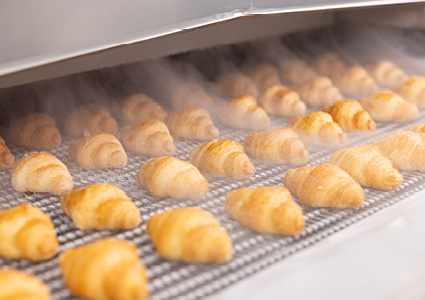
We also help to identify which cryogenic freezing solution is best suited to product and production requirements. By modelling the process and assessing factors such as heat transfer, throughput and liquid nitrogen demand, we can build a clear picture of expected performance and operating costs. This gives customers valuable insight into how cryogenic freezing could work within their operation, before any investment is made.
How can manufacturers feel confident in cryogenic freezing solutions?
We help to build confidence further with product trials at our research and development facilities in the UK and Spain. Customers can send us product samples to test freezing solutions and attend the trials themselves or review the results remotely. We can also send trial equipment to our customers to replicate real-world production conditions, helping to validate performance and reduce risk before moving forward.
This is a positive way of encouraging innovation in the food manufacturing space. By working together, manufacturers can proceed with new product lines with confidence, having tested product quality, yield and process suitability before moving forward.
Once installed, what separates a good freezing operation from a great one?
An effective freezing operation is all about continued optimization and evaluation. We always offer continued support to help train operators, monitor performance and optimize freezing processes to improve efficiency and reduce liquid nitrogen consumption.
By providing this ongoing support, we can make sure manufacturers are getting the best results from their cryogenic freezing technology. We can spot areas where performance can be improved even further and support customer objectives around innovation and portfolio expansion.
What role can cryogenic freezing play to help innovation and growth?
Cryogenic freezing technology is particularly advantageous because of its scalability and flexibility. The speed of installation and deployment means that new product lines can easily and quickly be trialed without committing to high capital expenditure. New lines can also be implemented to existing operations smoothly with minimal disruption.
This can be especially favorable for customers who want to roll out seasonal lines, respond quickly to new consumer trends or rapidly adapt to changing demands. In challenging market conditions, it can make a real difference to have the capacity and confidence to innovate without high commercial risk.
How important is data in cryogenic freezing operations?
Using data to keep on top of freezing performance can help to reduce product loss and increase efficiency. We help manufacturers with this using our Air Products Smart Technology (APST) platform to provide real-time and historical performance data from both the freezer and the liquid nitrogen supply system. The value lies not in the data itself, but in what it enables: better cost control, improved uptime, faster troubleshooting and more consistent quality overall.
We often see freezing processes drift as product characteristics or operating conditions change. Data helps us identify the underlying causes of an increase in nitrogen consumption, for example, warmer incoming product, inconsistent loading or over-freezing. We can use data to pinpoint the exact reason behind the increase. If product quality varies, data can support a structured investigation rather than relying solely on visual inspection or operator experience. Crucially, our ability to conduct these analyses remotely helps manufacturers respond to any potential issues as quickly as possible.
What do you think will shape the future of food freezing for manufacturers?
I think the role and use of data will continue to grow. As data quality improves and more is collected, it can be used to further improve freezing systems, and it is likely to support automation and the integration of AI technology.
Ultimately, the question I encourage manufacturers to ask is not simply, “Which freezer do we need?” but “What production capability are we trying to build?” Viewed that way, it becomes a strategic decision that helps manufacturers improve flexibility, launch products with confidence and compete in a market where quality, efficiency and adaptability matter.
Dr Jens Herrmann
www.airproducts.co.uk
Dr Jens Herrmann is Air Products’ Commercial Technology Lead for Food and Cryogenics in Europe. Air Products serves a broad range of industries, including refining, chemicals, metals, electronics, manufacturing, medical and food, providing essential industrial gases, technologies and applications expertise that enhance customers’ sustainability and improve their operations. As the leading global hydrogen supplier, Air Products also develops, engineers, builds, owns and operates some of the world’s largest hydrogen projects. Through its sale of equipment businesses, it provides turbomachinery, membrane systems and cryogenic containers globally.