How Dolly turned southern comfort food into an enduring consumer brand
Subscribe to our free newsletter today to keep up to date with the latest food industry news.
Dolly Parton built a career around songs people could remember, a personality they felt they knew and an image that was unmistakably her own. But another part of the entertainer’s commercial legacy can be found somewhere more ordinary: the American kitchen.
By the time Parton died at 80, her name had moved far beyond records, films and Dollywood. Consumers could buy Dolly Parton cake mixes, biscuits, brownies, frozen dinners, cookware, cookbooks and coffee. There was even a range of Dolly Wines.
Celebrity licensing is hardly unusual. What made Parton’s food brands notable was how naturally the products appeared to fit the person selling them.
The connection was Southern food.
Parton was born in rural Tennessee and grew up as one of 12 children. Food, family and the traditions of Southern cooking became recurring elements of the public identity she built over decades. When packaged-food manufacturers eventually put her name on cake mix and chicken and dumplings, they were commercialising an association that already existed.
That distinction helps explain how an initial collaboration in the baking aisle developed into a much broader consumer-products business.
From cake mix to a supermarket brand
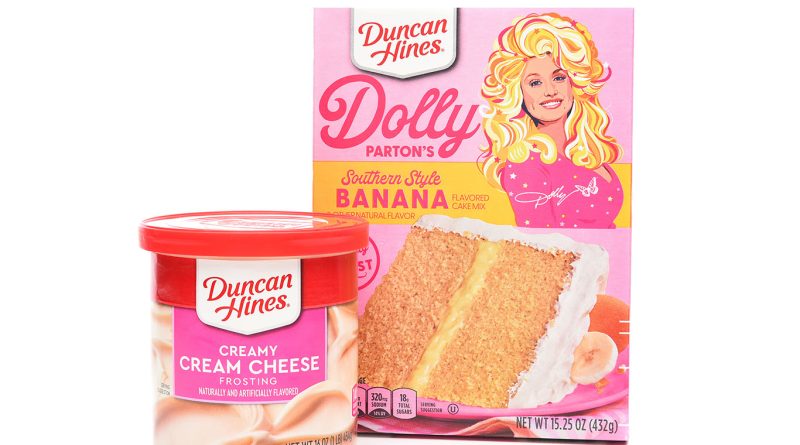
The modern Dolly Parton food portfolio began taking shape in 2022, when Conagra Brands’ Duncan Hines partnered with Parton to introduce a range of Southern-inspired baking products.
The initial collection included Southern Style Coconut Flavored Cake Mix, Southern Style Banana Flavored Cake Mix and two frostings. Conagra said the products drew inspiration from some of Parton’s favourite family recipes, including coconut cake and banana pudding cake.
It was a relatively conventional celebrity partnership, but the positioning was carefully chosen. Duncan Hines was not trying to transform Parton into a chef. Instead, it connected an established baking brand with Parton’s existing associations with Southern food, home cooking and family.
The formula worked.
A year later, Duncan Hines expanded the Dolly Parton baking line with buttermilk biscuit, sweet cornbread and muffin, fudgy brownie and caramel turtle brownie mixes. Conagra described the original collaboration as one of Duncan Hines’ most successful new baking innovations of 2022.
The significance of that expansion went beyond another four products. It demonstrated that consumers might accept Parton as more than the face of a limited-edition cake mix.
In January 2024, Conagra made a considerably bigger commitment. The company announced an exclusive licensing agreement with Parton covering frozen and refrigerated foods, grocery products and snacks. The partnership extended beyond the Duncan Hines brand and positioned Parton as the centre of a potentially much larger food portfolio.
For Conagra, the attraction was explicit. Then-Chief Operating Officer Tom McGough said the agreement offered the company an opportunity for growth in Southern cooking and comfort food.
That strategy turned a celebrity endorsement into something closer to a platform.
Parton’s image could sell a cake mix because consumers associated her with Southern baking. The same logic could be extended to pancakes, macaroni and cheese or peach cobbler without requiring a reinvention of the brand each time.
That consistency matters in a celebrity licensing market where fame alone does not necessarily give consumers a reason to buy a product twice.
Comfort food becomes big business
Conagra subsequently moved the Dolly Parton food brand deeper into the freezer aisle.
In 2025, the company launched single-serve meals including beef pot roast, chicken and dumplings, country fried steak and shrimp and grits. Each carried a suggested retail price of $4.49 and could be prepared in a microwave or oven.
By June 2026, the range was expanding again, with Conagra announcing new products as part of its summer introductions.
There was a broader consumer trend behind the strategy.
Conagra’s 2025 report on the frozen-food market said celebrity-inspired frozen products had generated more than $175 million in sales and were growing 22 percent year over year, citing Circana data for the period ending Oct. 20, 2024. The company singled out its collaboration with Parton as an example of consumers bringing familiar personalities into their at-home dining habits.
Parton therefore arrived in the freezer at an advantageous moment. But the portfolio also shows how carefully celebrity products can be designed around familiarity.
Chicken and dumplings, country fried steak and macaroni and cheese require little explanation to the American shopper. Pairing them with Parton added another layer of recognition.
The expansion did not stop at dinner.
In 2026, Parton announced Cup of Ambition, a coffee brand created with Community Coffee. The name itself demonstrated the commercial flexibility of her cultural catalogue, transforming a familiar lyric from “9 to 5” into a product designed around the morning coffee ritual.
The result was an increasingly interconnected collection of products. Consumers could bake with Dolly, eat a Dolly-branded dinner and begin the next morning with Dolly-branded coffee.
That is considerably more powerful than putting a famous photograph on a package. It creates repeated points of contact between a personality and everyday consumer behaviour.
From the supermarket to the kitchen cupboard
Food products represented only part of Parton’s presence in the kitchen.
Her first cookbook, “Dolly’s Dixie Fixin’s: Love, Laughter, and Lots of Good Food,” was released in 2006 and collected more than 100 recipes inspired by her childhood, family and career. Nearly two decades later, she and her sister Rachel Parton George published “Good Lookin’ Cookin’: A Year of Meals,” further strengthening the association between the Parton name and home cooking.
Cookware followed the same logic.
Parton partnered with Tennessee-based Lodge Cast Iron on a collection that turned her songs, imagery and personality into functional kitchen products.
The range included skillets featuring butterflies and references to Parton’s music. Lodge said the collection was designed around Parton’s music, films and personality, giving an established American cookware product a distinctive layer of cultural recognition.
Building a brand around the kitchen
Taken together, the products reveal a coherent licensing strategy.
The cookbooks provided recipes and stories. Duncan Hines supplied ingredients and baking mixes. Conagra moved the brand into ready-made meals. Lodge supplied the pans. Coffee added another daily occasion.
The connection between them was not merely Parton’s face. It was an idea of hospitality, comfort and Southern cooking that had been reinforced throughout her career.
That may become particularly important to the future of the business.
Can the Dolly Parton brand outlive Dolly?
The death of any celebrity behind a consumer brand creates an uncomfortable commercial question. A personality can no longer promote new products, appear in advertising or personally explain why a partnership fits. Brands built primarily on novelty risk becoming relics.
Parton’s food portfolio has a potentially stronger foundation.
Its products are rooted in themes that were part of her identity long before Duncan Hines approached the baking aisle. Family, Tennessee, Southern cooking and generosity were not created for a licensing campaign. The products monetised those associations, but they did not invent them.
That gives companies managing the Dolly Parton food brands an opportunity, and a responsibility.
Push the licensing too far and the authenticity that made the products convincing could disappear. A Parton-branded biscuit mix makes intuitive sense. Endless unrelated products bearing her name might not.
The stronger strategy is the one already visible in the kitchen: products that allow consumers to participate, however lightly, in the traditions Parton spent decades talking about.
That may prove to be one of the more durable lessons of her commercial career. Celebrity licensing works best when the celebrity is more than an audience acquisition tool. The person needs to give the product meaning.
Parton did that unusually well.
Her songs will remain the most visible part of her legacy, but a smaller expression of the same identity will continue in kitchens and grocery aisles. A cake mixed for a family gathering, chicken and dumplings pulled from a freezer, cornbread baked in a cast-iron skillet or coffee poured before work are mundane things.
Source: