How HOS Global Foods is connecting North America with authentic ethnic foods and flavors
HOS Global Foods (HOS), formerly known as House of Spices, has evolved from a New York City storefront into the largest South Asian food importer and distributor in North America. With ten distribution centers, more than 300 employees, over 1100 SKUs, and a range of in-house brands, HOS is on a mission to become a $500-million company. Following its recent rebrand, we sit down with CEO Neil Soni, and COO Amrapali Soni Ryan, who are also brother and sister, to learn more about what factors are fueling such impressive growth.

The story starts, as so many great food stories do, with a homesick family. “Our founder, G.L. Soni, originally came to New York for a civil engineering career, but his wife, Shobhna Soni, was a new bride in a new country, and there was simply nowhere to buy the dals, spices, and staples she needed to cook the food they had grown up on,” Amrapali begins. “That gap, and her hunger for the taste of home, became the founding inspiration for the business. In 1972, G.L. Soni opened one of New York City’s first stores devoted to Indian food products in Jackson Heights, alongside his wife and brother – and House of Spices was born.
“Out of that storefront grew our flagship brand, Laxmi, built on three promises that still guide us today: purity, quality, and value. Laxmi went on to become the most loved South Asian food brand in America, and 55 years later, the family spirit remains but the business around it looks very different. We have grown into a multi-channel food business, serving more than 3000 customers across mainstream grocery, ethnic and specialty stores, foodservice, clubs and e-commerce. Today, HOS is best understood as a bridge between global growers and the North American consumer, and our vision remains to bring our culture to life through the celebration of authentic food, flavor and family.”
Beyond distribution
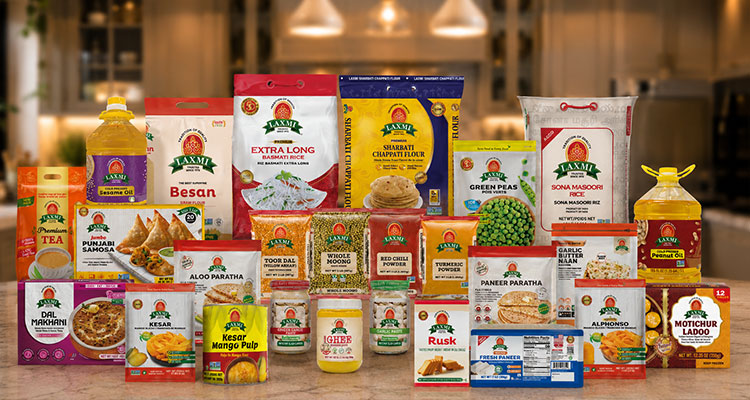
The company’s portfolio runs from everyday pantry essentials like rice, flours, lentils, spices, oils, ghee, and dals to a fast-growing range of specialty, frozen, ready-to-eat, and value-added products spanning pastes, snacks, beverages, instant mixes, dairy, pickles and chutneys, cookies, and confections. In total, the portfolio spans around 19 categories, with specific expertise in each. Beyond this, HOS has an in-house brand portfolio including Laxmi, Garvi Gujarat, Amma’s Kitchen, Maaza, and Meharban, each of which is designed to serve a specific occasion, region, or consumer.
“We are far more than a distributor,” Neil states. “Customers and brand partners use us as a go-to-market platform: import, quality assurance, and regulatory infrastructure; an in-house category and marketing team; product development capability built up over more than 20 years; access to mainstream grocery, ethnic retail, foodservice, clubs and e-commerce; and a domestic salesforce that is the largest of its kind in the South Asian channel. For a global brand looking to enter or scale in North America, we are effectively a turnkey operating system. Being candid about the rest of the category, a meaningful share of South Asian product on shelf in North America still moves through a fragmented broker-and-consolidator chain – sourced opportunistically, repacked in warehouses with limited hygiene oversight, and with very little visibility back to the original grower or mill. We deliberately do not operate that way. We go direct, we know our origins, and we control the chain ensuring hygiene and traceability end-to-end.”
HOS also operates its own brands, including Laxmi, which was honored in 2025 with a Multicultural Excellence Award by the Association of National Advertisers (ANA), making it the first ever South Asian Indian food brand to win in the program’s history. “This is one of the most meaningful moments in our history with Laxmi; for a category and a community that has been under-represented in mainstream advertising for decades, that recognition matters far beyond a trophy,” Amrapali shares.
The winning work was Laxmi’s Diwali campaign, ‘Diwali Ki Mithas Badhaane Ke Liye, Laxmi Hain Na’, which tells the story of an Indian couple living abroad who invite a group of Indian students into their home to celebrate Diwali together. “What begins as a small, generous gesture transforms homesickness into shared warmth, laughter, and a sense of belonging,” Neil narrates. “Food, in the film, becomes the language through which heritage is passed on – a very simple human truth that mirrors why Laxmi exists in the first place: to bring ‘home’ to the South Asian household, no matter where in the world that household happens to be.
“We extended the campaign in a way that matched that ambition. Laxmi illuminated Times Square with the Diwali film, putting a homegrown South Asian brand on one of the most iconic stages in global advertising. Internally, the win is a validation of a thesis we have been building toward for years: authentic, culturally-rooted storytelling is not a niche play. Done with craft, it can stand alongside any mainstream campaign, and it can move both hearts and household penetration.”
Authenticity as a foundation
Turning to the recent rebrand, Amrapali explains that the transition from House of Spices to HOS Global Foods is best understood as catching up to the company it had already become. “Our original name served us beautifully for five decades, but it described a category, not the business – we are no longer just ‘the spice house’,” she says. “Strategically, the rebrand does three things: signals our evolution from a regional ethnic distributor into a global food platform; expands our relevance beyond the South Asian consumer into broader multicultural and mainstream audiences; and aligns the brand with our ambition to operate as a scaled, institutional-grade organization. It’s not just a name change; it’s a re-statement of how we show up to customers, partners, and the next generation of food entrepreneurs.”
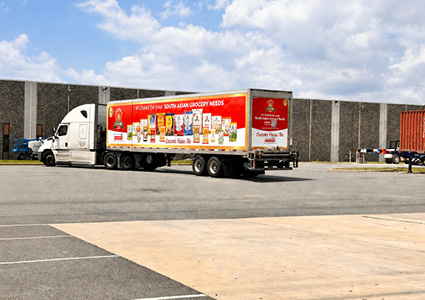
As Amrapali explains, rebranding is a key step to HOS becoming a $500-million business. “Our infrastructure investments are deliberately tied to the economics of scale,” Neil adds. “New buildings give us throughput, automation potential, and inventory depth, while fleet expansion gives us delivery control, tighter SLAs, and better cost-per-mile while reducing our dependency on third-party carriers. With over one million square feet of capacity already live, and continued expansion underway, we have the runway to confidently take on larger national accounts and category programs without compromising on the freshness and authenticity our consumers expect.”
Authenticity is a common theme throughout our conversation, but it’s the company’s approach to relationships that has solidified this concept. “We’ve spent more than 50 years building relationships with growers and processors around the world, and they give us four things that are very hard to replicate: quality consistency at the source, traceability we can stand behind, cost competitiveness through fewer intermediaries, and the ability to support an importer-of-record model with full QA and regulatory coverage,” Amrapali shares.
“We see authenticity as a foundation, not a constraint. For Laxmi specifically, we start by protecting the things that matter most: true regional flavors, traditional formats, and the right grain, grind, and sourcing region. Then, we adapt the layer around that core, such as packaging, education, occasion-based messaging, channel strategy, and accessibility. We make it easy for a first-generation South Asian household to find Laxmi in their familiar ethnic store, and equally easy for a curious mainstream shopper to discover it in a national chain or online, with cues that explain the product without diluting it. The goal is to make authentic food approachable, not to compromise it.”
Heritage and innovation
With ambitious growth plans and strategic expansion underway, HOS is clearly committed to being a global food brand that brings people together through consistent quality and authentic flavors. “What has been consistent over 55 years is our ability to evolve while staying grounded in our roots, and our mission to bring our culture to life through the celebration of authentic food, flavor, and family has never wavered,” Neil shares. “That balance between heritage and innovation will continue to define how we grow and differentiate ourselves.
“Our current priorities are focused on executing the next phase of infrastructure expansion, improving operational efficiency through automation and network optimization, and continuing to build organizational depth that will carry our next wave of growth without strain,” Neil concludes. “Over the next five years, our ambition is to be a $500 million-plus revenue company anchored by a nationally recognized portfolio of in-house brands, deep penetration in both ethnic and mainstream retail, and a highly efficient, scalable distribution and sourcing platform. We want to be the leading multicultural food company in North America, making the food of the world’s largest diasporas accessible, authentic, and beloved across every channel.”