
How to Choose an FSSC 22000 Certification Body for Your Food Business
In This Article
This article contains:
- 1. Confirm Your Certifier Holds an Active FSSC 22000 License
- 2. Watch for Certifiers Blurring the Line Between Auditing and Consulting
- 3. Look for Deep Food-Industry Auditor Experience
- 4. Get a Transparent, Itemized Quote Before You Sign
- 5. Find a Certification Body That Gets This Right
- Frequently Asked Questions
Your certification budget needs to cover an audit that aligns with your operations and a certificate that your customers accept. Choosing an FSSC 22000 certification body for your food business starts with checking its license, independence, auditor competence and pricing. Work through those checks before comparing providers and committing your audit budget.
1. Confirm Your Certifier Holds an Active FSSC 22000 License
Begin with the scheme owner’s register of licensed FSSC certification bodies before requesting proposals. Foundation FSSC prohibits providers from promoting or selling its services without a signed license agreement. Check the legal entity that would issue your certificate, its active status and its listed scope.
Treat accreditation and scheme licensing as separate checks. Accreditation concerns a certification body’s competence within a defined scope, while licensing authorizes participation in Food Safety System Certification (FSSC) 22000. Request the current evidence for your food chain category and the applicable scheme version.
For international operations, the global accreditation recognition framework changed in January 2026 when Global Accreditation Cooperation Incorporated began operations. Existing recognitions continue during the transition. Ask providers to explain the recognition arrangements relevant to your target markets.
2. Watch for Certifiers Blurring the Line Between Auditing and Consulting
Ask who would develop your system and who would assess it. Having a certification body design your controls or write your documented information before auditing that work creates a self-review risk. Request an explanation of how the provider separates certification from implementation consulting and manages auditor conflicts of interest.
Examine bundled offers carefully, especially packages combining system development with a guaranteed certification outcome. Ask what any preassessment includes, who delivers it and whether it identifies gaps without designing solutions. Keep your implementation responsibilities clear throughout the engagement. Distinguish optional gap identification from consulting that prescribes solutions.
3. Look for Deep Food-Industry Auditor Experience
Ask prospective providers to identify the food chain categories their proposed auditors cover. The ISO 22003-1 competence requirements provide a framework for auditing and certifying food safety management systems. Request evidence that the assigned team understands your processes and relevant hazards.
Check qualifications and practical experience in hazard analysis and critical control points (HACCP), food safety management and applicable regulations. Ask how the team would approach your manufacturing lines, distribution facilities or catering operations. Discuss auditor continuity across surveillance and recertification visits.
For multiple locations, the Global Food Safety Initiative introduced updated multisite certification guidelines in its 2024 Benchmarking Requirements. Ask whether your activities qualify for multisite certification and how the proposed audit scope would cover each operation.
4. Get a Transparent, Itemized Quote Before You Sign
Request a written breakdown covering audit days, certification fees, travel and surveillance visits. Ask separately about nonconformity follow-ups, certificate amendments, rescheduling and delays. Confirm which facilities, activities and food chain categories the quoted scope includes.
Compare proposals across the full three-year cycle using the same assumptions. Request clear terms for additional charges and establish who approves changes before costs arise.
Consider wider financial exposure carefully. The cost of food safety noncompliance for food importers subject to the Foreign Supplier Verification Program includes operational disruptions and reputational damage. Keep those regulatory obligations separate from the certification services you purchase.
5. Find a Certification Body That Gets This Right
Consider these top three providers, then apply the same checks to each proposal. Plan for annual surveillance audits and recertification every three years when discussing ongoing services. Ask each provider to explain scheduling, responsibilities and charges throughout that cycle.
NQA
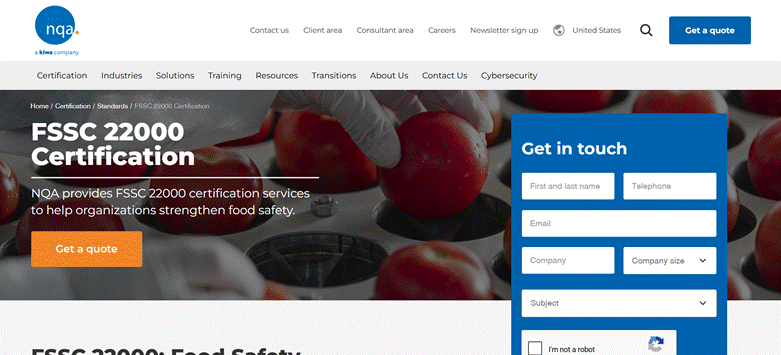
For accredited management system certification, NQA describes services for food manufacturing and related supply chain activities. Its FSSC 22000 process includes an initial two-stage audit and ongoing certification assessments. NQA also states that Foundation FSSC auditors may witness its auditors during scheme audits. With international operations, it offers a starting point for discussing category coverage, local auditor availability and communication about changing requirements across your locations.
SGS
For testing, inspection and certification services, SGS operates internationally across multiple industries. Its FSSC 22000 offering includes auditing and certification of food safety management systems. Ask whether an optional preassessment is available for your location and what it covers. Discuss auditor competence, impartiality, surveillance and recertification arrangements alongside regional availability so you can evaluate the service against your facilities and operational requirements before signing a contract.
Bureau Veritas
For another international testing, inspection and certification provider, Bureau Veritas includes agri-food among its service areas. Its FSSC 22000 offering includes audits of food safety management systems. Ask about optional preaudits, their availability and how they identify gaps without prescribing solutions. Review surveillance and recertification arrangements, sector competence and geographic coverage against the same requirements you share with the other shortlisted providers before making your selection.
Frequently Asked Questions
Use these answers to revisit the essential checks. Confirm the details with your shortlisted providers before signing.
How do you confirm a certification body is actually licensed for FSSC 22000?
Check Foundation FSSC’s register for the issuing entity’s active status and scope. Request current accreditation evidence for your relevant food chain category.
Why shouldn’t a certification body also offer consulting services?
Auditing a system the certifier helped design creates a self-review risk. Ask how it separates implementation consulting from certification and manages conflicts of interest.
How often does FSSC 22000 certification need to be renewed?
Plan for recertification every three years. Annual surveillance audits form part of maintaining certification during that cycle.
Build Your Food Safety Program on the Right Foundation
Choose your certification body by checking its active license, independence, relevant auditor competence and full-cycle pricing. Request written confirmation of its scope, responsibilities and charges, then consider how audit scheduling and communication would fit your operations as facilities or activities change. Taking a long-term view gives you a practical basis for comparing providers and managing your certification relationship over time.
*Please note that this list includes sponsored content. Some of the companies, products, or services featured have entered into commercial agreements for placement. Sponsored placements do not necessarily reflect an endorsement and should be considered alongside other options in the marketplace.