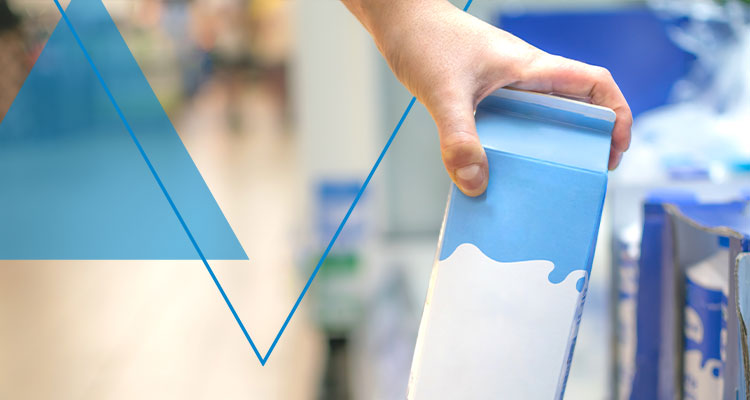
Katie Carson, Director for Corporate Affairs Food & Climate Policy at Tetra Pak, discusses how aseptic packaging strengthens food security
What is the role of packaging in food systems?
Packaging’s primary role in food systems is to protect food from contamination, extend shelf life, and enable safe distribution across the supply chain. Packaging’s ability to extend shelf-life is a key factor in expanding food access across the world, including regions far from farms or with limited or no access to refrigeration.
Aseptic carton packaging technology achieves this by enabling shelf life of up to a year without preservatives or cold chain distribution. This creates greater flexibility in how food can be stored and distributed, providing another pathway alongside refrigerated distribution to help food reach people safely. And because shelf-stable packaging protects food from spoiling, it also helps reduce food waste.

Without effective packaging, supply chains are put at risk, waste increases, and costs rise for households and governments alike. That’s why we believe packaging should be recognized as critical infrastructure for resilient food systems and societies.
How does packaging help producers meet differing needs in different places?
As food and beverages travel along the supply chain, packaging must be able to handle a variety of transportation, storage, and distribution conditions and challenges. The container of each food product needs to be robust enough to withstand logistics handling and protect the food and drink inside while transported and stored at different temperatures.
Where cold chain infrastructure is limited or unreliable, packaging that keeps food safe at ambient temperature is essential. In rural areas and emerging markets, aseptic carton technology means shelf-stable products can reach remote communities, informal retail settings, and small community shops. By reducing dependence on continuous refrigeration, this gives producers greater flexibility in how they distribute food and reach consumers across markets with different infrastructure and conditions.
Aseptic packaging and processing meet a diverse variety of requirements for different products, too, whether it’s juice, nectars, still drinks or dairy products. And the flat, printable surfaces of cartons provide food and beverage producers with the opportunity for brand storytelling that helps them communicate with consumers that may have specific needs, preferences or desires in different markets.
How can packaging help to strengthen the resilience of food systems?
Packaging is a key component of a resilient food system, because we need food systems that can cope when circumstances change. Extreme weather events, geopolitical instability, energy price volatility, and other disruptions can put pressure on supply chains and the infrastructure they depend on. In France, a recent cyberattack targeting supermarket refrigeration systems resulted in fresh and frozen food being destroyed at affected stores.
This underlines the value of having multiple pathways to keep food safe and available. Shelf-
stable formats that protect food for longer without dependence on continuous refrigeration give food systems greater flexibility, helping food reach consumers safely even when conditions change or critical infrastructure is disrupted.
A move towards circular food systems will also help to keep raw materials in use, improve efficiency, and help to weather shocks. To drive progress towards circularity, we take a lifecycle approach addressing every stage of a food and beverage carton’s journey. We design our cartons to be recyclable, in line with recognized design-for-recycling guidelines.
Once cartons reach the hands of consumers, we work with customers, recyclers, policymakers, and other stakeholders to help strengthen collection and recycling systems. Beyond collection and recycling, we also support the development of end markets for recycled materials, helping to keep valuable resources in use and enabling them to be reintroduced into new products.
Can ambient and shelf-stable formats help reduce food loss and waste?
Packaging is a crucial lever for reducing food waste. Where perishable food might spoil sitting on a hot dock or in broken cold storage, shelf-stable food stored and transported at ambient temperatures is less likely to spoil quickly when the supply chain is interrupted.

For producers, reducing waste is a commercial priority. Less wasted product helps lower costs by maximizing the use of raw materials and slashing losses. Improving efficiency and productivity can help producers remain competitive, invest for the future, and respond to changing consumer and market needs.
How should policymakers plan for supply chain disruption?
Policymakers and manufacturers need to recognize that food systems are complex, with all kinds of interlocking challenges. Even when disruption originates outside of agriculture, such as the global pandemic, geopolitical conflict, and energy volatility, they quickly translate into higher food prices, disrupted supply chains, and uncertainty for producers and consumers alike. To future-proof our food systems, siloed solutions aren’t enough.
Only a systems approach will bring about urgently needed change. Industry and policymakers must assess and monitor the entire value chain at a systems level, so they can plan ahead and manage disruptions. This must include an especially critical but often-overlooked part of our food systems: the “critical middle” of the food value chain. The processing, packaging, storage, logistics, and distribution stages get food from producer to consumer, yet despite their importance to food security and resilience, these parts of the system can be overlooked. Strengthening them can also help food producers remain competitive, improve productivity, invest for the future and respond to changing consumer and market needs. Policymakers can play a role here by incentivizing innovation and investment to strengthen these crucial areas.
In the future, what does a more resilient food system look like, and how will packaging contribute to that transformation?
To build the food systems of the future, we face a critical need for solutions that will lower energy use, cut emissions, and improve efficiency across the value chain, without compromising on food safety, access or affordability.
The changes we make today must equip Europe’s food system for a future defined by volatility, climate pressure, and global competition. Innovation will be key. New developments in processing and packaging can reduce waste and extend shelf life, while in plants and factories, digitalized production systems can help industry respond to disruption, and automation helps address labor shortages and improves productivity.
Ambient distribution enabled by aseptic processing and packaging helps build in urgently needed flexibility, operating alongside the cold chain for multiple pathways to deliver safe, nutritious food when refrigeration is limited, disrupted or simply not practical.
Ultimately, food security isn’t only about growing enough food. It’s about ensuring that food stays safe, nutritious, available, and affordable from farm gate to consumer, through every step of an increasingly complex global supply chain. Packaging should not be overlooked as a vital part of the value chain of the future, helping to make our global food systems flexible, resource-efficient, and more resilient.
Katie Carson
www.tetrapak.com/en-gb
Katie Carson is Director for Corporate Affairs Food & Climate Policy at Tetra Pak. Katie has over 20 years of policy and advocacy experience in the agri-food sector. She joined Tetra Pak in 2022 and is responsible for leading the Tetra Pak Food and Climate advocacy agenda, as well as building out the company’s sustainable food systems strategy with a focus on the enabling role of food processing technologies and packaging solutions in the transition to more sustainable food systems.