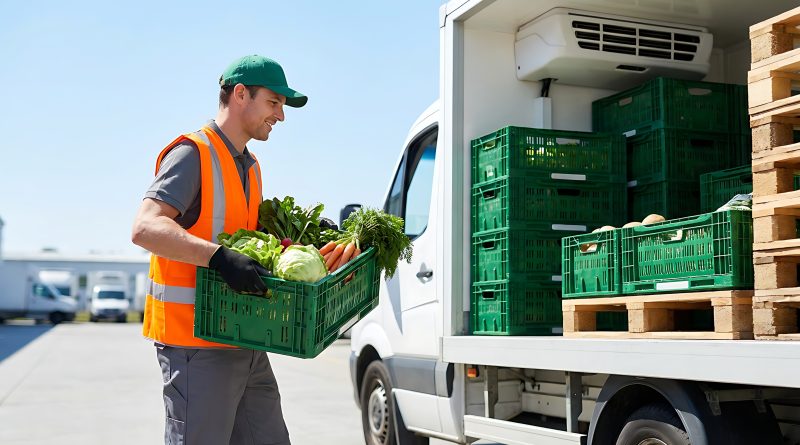
Last Mile Distribution From The Fleet to The Table
Navigating the New Matrix of Last-Mile and Wholesale Food & Beverage Distribution.
If you operate a fleet in the North American food and beverage industry, you are acutely aware that the order lifecycle isn’t just about moving boxes; it is a high-stakes race against time, temperature, and razor-thin grocery wholesale margins. The final mile and wholesale distribution legs have always been critical to customer retention, but today, they represent the ultimate differentiator between industry leaders and lagging operations.
Driven by shifting consumer preferences for fresh, organic, and frozen categories, temperature-controlled logistics are advancing at a rapid pace. This growth has fundamentally overhauled distribution demands. Grocers, restaurants, and institutional buyers no longer tolerate wide delivery windows or partial orders. According to recent industry data, a staggering 56% of North American food and beverage leaders rank regulatory compliance, policy shifts, and volatile operating environments as their top decision drivers. To achieve long-term operational peace of mind and protect your margins, your business must master a complex machine comprised of numerous moving parts:
- Strict multi-temperature parameters,
- Rigid retailer receiving windows, and
- Urban chokepoints.
Three definitive trends are currently cementing this shifting roadway:
- The e-commerce paradigm shift,
- The same-day delivery squeeze, and
- The interdependence of driver and customer experience.
The E-Commerce Paradigm Shift
E-commerce has crossed unprecedented global thresholds, signaling a permanent behavioral shift that heavily impacts both traditional business-to-consumer (B2C) grocery delivery and business-to-business (B2B) wholesale environments. Large broadline foodservice distributors and regional beverage providers suddenly have to absorb unpredictable e-commerce volumes alongside their static, fixed-day master routes.
Managing non-traditional delivery volumes means you can no longer afford rigid, isolated routing systems. Multi-product fleets require technical solutions that connect the immediate fulfillment needs of customers without crushing operational teams or sacrificing profitability. To position your fleet as a pioneer, you must implement systems that quickly find capacity in multi-temperature trailers to balance traditional wholesale manifests with express e-commerce additions. Furthermore, real-time route navigation is critical to helping dispatchers and drivers adapt to fluid traffic changes, preventing transit delays that risk product spoilage.
The Same-Day Delivery Squeeze
The delivery benchmark has contracted rapidly, transitioning from next-day fulfillment to strict same-day delivery parameters. For food and beverage operators, same-day delivery introduces extreme operational pressure. Once an order is placed within the morning cutoff window, the distributor must immediately pick the inventory, stage it across multi-temperature cross-docks, and transfer it onto a localized last-mile asset.
Every time delivery windows contract, fleets face a delicate balancing act between satisfying customer expectations and absorbing soaring per-mile operational costs. This reality has forced many food production companies to partner with specialized last-mile fleets rather than relying entirely on overextended in-house networks. The business stakes are clear: a significant portion of younger demographics report higher brand loyalty to businesses that provide seamless same-day delivery service. To capture these benefits, fleets must deploy routing algorithms capable of working same-day, last-minute orders into active driver routes with minimal disruption.
The Interdependence of Driver and Customer Experience
Customer experience is the number-one driver of modern technical innovation in the food and beverage logistics sector. However, in food distribution, your drivers are the customer experience. A delivery driver does far more than transport refrigerated cargo; they serve as a critical brand ambassador and the primary face-to-face contact point for your brand.
To insulate your business from costly driver churn, you must protect your frontline staff from administrative fatigue, chaotic routing, and unrealistic schedules. Providing a consistent customer experience goes hand-in-hand with cultivating a supportive, stress-free driver environment. In the high-velocity wholesale environment, B2B buyers are busy servicing their own clients and do not have time to trace inventory via manual, repetitive phone inquiries. Proactive order notifications give visibility back to the customer, automatically broadcasting the exact status, location, and ETA of every case coming off the truck.
The Solera Advantage
As disruptive trends emerge, your underlying distribution technology must evolve in unison. At the center of this evolution sits a crucial constant, your customer’s expectations. Solera Fleet Solutions leverages its deep legacy and massive volume of accumulated data to build sophisticated algorithms that transform raw information into a competitive edge. By converting data from both compliance and video systems into actionable insights, Solera helps fleets optimize maintenance, execute precision coaching, and slash operational waste. Partner with Solera to simplify your technology stack, lower your equipment downtime, keep your drivers satisfied, and protect your margins across every mile.
Solera doesn’t just make your Routing efficient, it helps you achieve Safer Roads, Happier Drivers and More Productive Fleets.
Download our eBook “Simplifying Routing for Food and Beverage Fleets” to know more.
*Please note that this list includes sponsored content. Some of the companies, products, or services featured have entered into commercial agreements for placement. Sponsored placements do not necessarily reflect an endorsement and should be considered alongside other options in the marketplace.