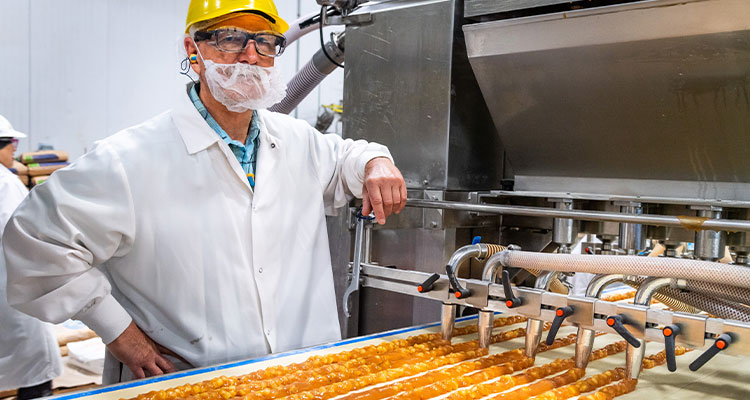

Lone Star Bakery brings together family ownership, manufacturing scale, and investment to drive growthnationwide
When Tracy Fletcher was 16, she spent her summers working at the family bakery, rotating through dif-ferent departments. Now, three decades later, Tracy is the third-generation President of Lone Star Bakery (Lone Star). She leads a company with nearly 700 employees working across two manufacturing facilities in China Grove, Texas. The business her grandfather bought in 1956 now serves restaurant chains, retailers, distributors, and food companies throughout the US and abroad.
When Tracy thinks about the operation built by the first generation of her family, the Morrises, she says they’d be amazed by how far the company has come. “Back in the 1950s, they probably had about 30 em-ployees. Today, our reach extends nationwide and internationally. And the technology—well, the tools and systems we use now just weren’t around when they were building this business.”
Technology shapes the business today, but Tracy’s leadership roots go back to those early days on the production floor. “Working on the floor in different departments gave me the chance to learn from people who were true experts. They mentored me and showed me how every piece of the business works. That hands-on experience, and watching how our teams work together, really shaped me as a leader.” Her ap-proach still reflects those lessons, even as the workforce has grown far beyond what it was when she started as a teenager. Tracy adds, “I try to lead with compassion and remember that we’re all human. It gets harder to keep that family-business culture as we grow, but we’re committed to it.”
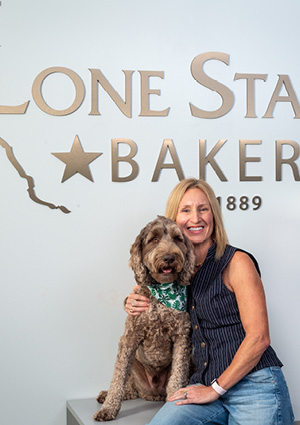
That family spirit even has four legs. Harvey, Lone Star’s unofficial Chief Morale Officer, spends his days at the front desk with the receptionist, greeting guests and delivery drivers and offering employees a quick dose of therapy whenever they need it.
Product innovation
After more than 20 years with Lone Star, Director of Sales Dave Sumner has built a network of customer relationships that keeps opening new doors. Many opportunities come their way because customers al-ready know how the company operates. Dave notes, “There’s not a lot of red tape here. We have a small team involved in decisions, so we can get to the key issues quickly and figure out if we can move forward with a project.”
Rather than leading with a product idea, Lone Star starts by understanding how its customers operate. Dave explains, “We’ve gotten in the habit of learning what equipment our customers use. That helps us design products that fit their format and make things easier for them.”
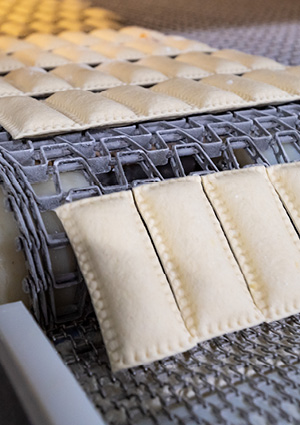
Biscuits remain Lone Star’s largest product category, but fried pies continue to drive menu innovation, new flavors, and creative applications. Interest is growing beyond just sweet pies. Dave adds, “We’ve started developing savory flavors like sausage and gravy, and chicken and vegetable pies. These products are cre-ating new opportunities for us and generating interest right alongside our sweet varieties.”
When it comes to the fried pies, the options for fillings are virtually endless. Execution for the operator, however, stays simple. “The pies come frozen and ready to fry,” Dave says. “The handler simply takes them out of the freezer, drops them in the fryer for six minutes, and they’re ready to serve. They can even hold under a heat lamp for up to two hours.”
Enhancing efficiencies
Expanding the product range is only part of the challenge. Testing, adapting, and scaling those products is
just as important. Since joining Lone Star in 2012, Chief Engineer Mike Brehm has built a team that handles maintenance, fabrication, refrigeration, automation, programming, and equipment development for both facilities. Mike notes, “When new opportunities come up, our internal departments can step in, even if we don’t have exactly what we need on hand. Our machine and fabrication shops let us create what’s needed quickly, so we can test or run new products right away.”
Those resources are now focused on a series of investments meant to increase output and reduce manual processes. Lone Star is automating two production lines and increasing pie production with a new EasyMac sheeting line. The investments also include upgrades to refrigeration, packaging, freezing systems, and support equipment across both facilities. Mike points out, “The main reason for the second pie line was simple: we were out of capacity.”
That same thinking is guiding changes in Lone Star’s frozen dough operations. Mike continues, “We’re working to streamline it all. The frozen dough pucks will come out of the spirals frozen and go straight into packaging equipment vs how we have to currently bulk pack, then next day load to a bagging machine for retail.”
The investment program spans both Lone Star facilities and requires coordination far beyond engineering. Having two plants just a few miles apart gives the company real adaptability as production demands shift. Tracy explains, “We share resources across both sites. Mike oversees engineering at both facilities, and our manufacturing and maintenance teams work at both locations. It gives us visibility across the whole opera-tion and lets us schedule employees between plants to keep them cross-trained and ready to support production wherever demand is highest.”
Mike shares, “We meet weekly to keep everyone up to speed on projects, new items, and scheduling. We also meet daily at both plants. We talk about what’s needed and what’s running at each facility so we can make sure the right people are in the right place. Someone might be based at one site, but that doesn’t stop them from helping at the other whenever it’s needed.”
Physical changes across the plants are matched by changes in how information flows through the business. One of Lone Star’s biggest initiatives has been implementing Redzone. The platform began as a way to track production and downtime, but now supports quality processes, sanitation, employee training, safety, and communication throughout the company. Tracy remarks, “It’s a huge communications boost for us.”
And there’s more investment on the horizon. Lone Star is preparing to build an 8000-square-foot R&D and pilot facility while adding capacity and growing its workforce. These projects keep Tracy, Dave, and Mike working closely together. Customer demand sparks opportunity. Engineering determines how quickly those ideas become reality. Leadership chooses where to invest next. But for Dave, the goal is simple: “Fill up the production lines Mike is building.”