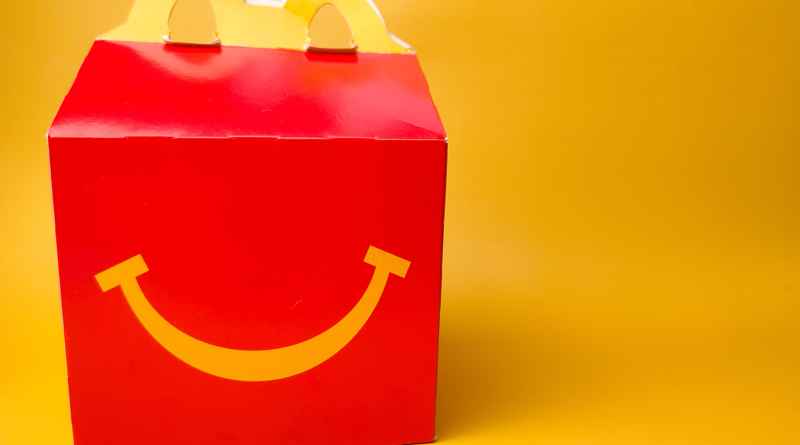
McDonald’s brings Hello Kitty and Godzilla together in an unlikely Happy Meal crossover
Subscribe to our free newsletter today to keep up to date with the latest food industry news.
McDonald’s has spent decades perfecting a simple formula: put something collectible next to a familiar meal and give customers a reason to come back.
Its latest collaboration may be one of the clearest examples yet of how that formula has evolved.
The fast-food giant is bringing Hello Kitty and Godzilla together for a limited-edition Happy Meal collection, pairing Sanrio’s famously cute characters with some of Japanese cinema’s most recognizable monsters.
The Hello Kitty and Friends x Godzilla Happy Meal launches at participating McDonald’s restaurants in the U.S. from Aug. 18, with eight collectible toys available. The meal itself offers the familiar choice of a hamburger or Chicken McNuggets, but for many customers the food is unlikely to be the principal attraction.
The collection transforms Sanrio characters into creatures from the Godzilla universe. Hello Kitty becomes Godzilla, Chococat is SpaceGodzilla and Kuromi takes on Mechagodzilla. Keroppi appears as King Ghidorah, Badtz-Maru becomes Rodan and My Melody is paired with Mothra. Cinnamoroll takes on Destoroyah, while Pompompurin becomes Gigan.
It is an unusual combination, but that may be precisely the point.
Happy Meals are becoming pop culture platforms
The Happy Meal has traditionally occupied a straightforward position in McDonald’s business: a smaller meal for children accompanied by a toy. Increasingly, however, its collaborations have been designed to appeal to customers considerably older than the traditional Happy Meal audience.
Recent promotions have drawn on entertainment and cultural properties including Super Mario, “Stranger Things,” BTS-related characters and the FIFA World Cup. Hello Kitty has already demonstrated her ability to move between brands and audiences, including a previous McDonald’s crossover with Teenage Mutant Ninja Turtles. McDonald’s material from that 2025 promotion presented the characters as part of a shared adventure, effectively combining two established franchises into a single collectible concept.
That approach makes commercial sense in a consumer market increasingly shaped by fandom.
For McDonald’s, a recognizable intellectual property can turn an inexpensive toy into a reason for repeat visits. A collection of eight figures also changes the proposition. Customers are no longer necessarily purchasing one Happy Meal for one toy. Collectors may want several, while duplicates can encourage further purchases or trading.
Online reaction ahead of the latest release suggests that some customers are already thinking that way.
In Godzilla and Hello Kitty communities on Reddit, users have discussed plans to collect the entire series, with some joking about the number of Happy Meals required. One highly engaged Godzilla discussion attracted more than 1,000 votes, while another Hello Kitty community discussion included fans talking about returning for multiple meals.
That enthusiasm is not proof that the promotion will sell out nationally, and availability is likely to differ between restaurants. But it demonstrates the advantage of combining two established fan bases rather than relying on one.
Hello Kitty brings an audience spanning children, fashion consumers and adult collectors. Godzilla brings decades of film history and an international following of its own. Put the two together and McDonald’s gets something more valuable than familiarity: novelty.
Why Hello Kitty remains a collaboration powerhouse
Hello Kitty is particularly suited to this kind of brand partnership because the character has never been confined to one product category.
Sanrio describes Hello Kitty as a character born in the suburbs of London who enjoys baking cookies and making friends. That deliberately simple identity has proved remarkably adaptable. The character can appear on toys, clothing and household products without requiring consumers to understand a complicated story or fictional universe.
That flexibility has helped Hello Kitty become a recurring presence in collaborations.
In 2026 alone, Sanrio partnered with Kura Sushi USA for a limited-time Hello Kitty and Friends dining experience across 84 restaurants. The promotion included capsule prizes, special menu products, restaurant decorations and other merchandise.
McDonald’s has similarly returned to Sanrio properties repeatedly. Previous Happy Meal promotions have paired Hello Kitty and Friends with Yu-Gi-Oh! and Teenage Mutant Ninja Turtles.
The Godzilla partnership pushes that strategy further because the contrast is part of the product.
Hello Kitty’s rounded design and carefully cultivated cuteness sit at the opposite end of the visual spectrum from a giant monster associated with flattened cities and cinematic destruction. The resulting figures work because consumers recognize both sides of the joke immediately.
It is also an example of how character licensing has moved beyond straightforward merchandising. Rather than simply putting Hello Kitty or Godzilla on packaging, brands increasingly create mash-ups that offer something consumers cannot get from either franchise independently.
For collectors, that distinction matters. Scarcity and novelty can turn a small promotional object into a desirable piece of merchandise.
McDonald’s is selling collectibility as much as food
There is another reason the promotion stands out: Happy Meal toys now exist in an environment where adult collecting is highly visible.
Sneakers, trading cards, figurines and limited-edition brand collaborations have helped normalize the idea of adults pursuing products once associated primarily with children. Social media amplifies the phenomenon by allowing collectors to show complete sets, compare finds and identify which items are proving difficult to obtain.
The Hello Kitty and Godzilla release was generating that behavior before its official rollout. Some Reddit users reported encountering toys early, while others said their local restaurants had not yet received them. Those anecdotal reports underline an important part of the collecting experience: distribution can vary significantly between locations.
That unpredictability can itself fuel demand.
A Happy Meal toy is inexpensive compared with most licensed collectibles. But a customer trying to complete an eight-character set faces an entirely different proposition. The possibility of duplicates, different stock at different restaurants and a limited promotional window all introduce scarcity into what would otherwise be an everyday purchase.
For McDonald’s, the strategy offers a way to make one of its oldest products culturally relevant again.
The Happy Meal does not need to compete directly with specialist collectible brands. Its advantage is accessibility. McDonald’s restaurants are familiar, the purchase is relatively inexpensive and the collectible comes attached to something customers already understand.
Meanwhile, the choice of Hello Kitty and Godzilla allows the company to address several generations simultaneously. Children can respond to the toys as characters. Longtime Sanrio and Godzilla fans can approach them as collectibles. Parents who grew up with either franchise have another reason to participate.
That crossover appeal explains why the strangest element of the promotion may also be its smartest.
Hello Kitty and Godzilla have little obvious reason to inhabit the same universe. One represents friendship, bows and carefully engineered cuteness. The other became famous as a towering radioactive monster.
At McDonald’s, that incompatibility has become the selling point.
And with eight characters to find and a limited window in which to find them, one Happy Meal may not be enough.
Source: