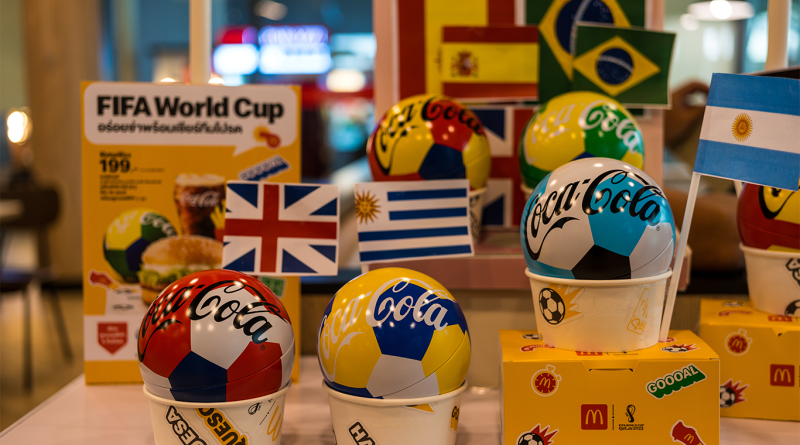
McDonald’s closes a 32-year World Cup chapter after a tough summer
Subscribe to our free newsletter today to keep up to date with the latest food and beverage news.
McDonald’s is ending its FIFA World Cup sponsorship, closing a relationship that began with the 1994 tournament in the US and ran for 32 years.
The company confirmed in a statement that its current agreement concludes with this summer’s men’s World Cup, co-hosted by the US, Canada, and Mexico. The decision follows a 2026 tournament campaign that McDonald’s called its largest marketing push of the year, and one that fell short of what the business expected.
This matters well beyond football. McDonald’s is one of the most visible marketers in foodservice, and where it chooses to spend shapes how rivals think about big sponsorship deals.
A record World Cup campaign fell short of expectations
The 2026 tournament was meant to be a showcase. McDonald’s built its biggest World Cup campaign to date, created by Wieden+Kennedy New York and rolled out across its international markets.
Results did not match the ambition. On the company’s second-quarter earnings call, chief financial officer Ian Borden said the campaign “underperformed versus our expectations.” He added that it still gave the business a lift and generated strong excitement across the system.
The wider numbers help explain the pressure. US same-store sales rose 0.8% in the second quarter, and the company expects them to decline in the current period. For a chain of McDonald’s size, that is thin growth at a time when it has spent heavily to bring customers through the door.
A sponsorship that costs a great deal and fails to move traffic becomes an easy target when a marketing budget is under review. McDonald’s has said the decision is unrelated to recent turbulence at FIFA, including tensions between FIFA and UEFA.
McDonald’s wants to rely less on borrowed IP
The bigger story is where the money goes next. Chief marketing officer Morgan Flatley said in an interview: “I think we’ve become overly reliant on borrowed IP.” Borrowed IP refers to licensed properties such as sports tournaments, films, and entertainment franchises that a brand pays to attach itself to, rather than assets it owns outright.
Flatley’s view is that these tie-ins should be used selectively and only occasionally. The shift points McDonald’s toward its own brand properties, which it controls all year and does not have to rent from a rights holder every 4 years.
That logic will be familiar to anyone managing a food or beverage brand. A global tournament delivers a few weeks of intense attention. After that, the association fades and the next campaign starts from scratch. Owned properties can build value over many years.
McDonald’s is not leaving sport altogether. It says it will keep using sport and culture to connect with fans, with a sharper focus on year-round experiences. It remains title partner of France’s Ligue 1, continues to back Formula 1 in Latin America and the McDonald’s All American Games, and has signed a deal naming a Chicago Fire FC stadium McDonald’s Park.
That mix suggests a preference for longer-running, more local partnerships over a single global event.
FIFA now has a gap to fill
For FIFA, the exit leaves a high-profile restaurant category open. It will be looking for a new partner, ideally before the 2027 Women’s World Cup in Brazil.
Rival chains could see an opening. A global burger or chicken brand might view the World Cup as a chance to reach audiences McDonald’s has held for 3 decades.
Others may read the same evidence as a warning. If the most experienced sponsor in the category concluded that the returns no longer justified the cost, a newcomer would need a strong case to pay for the same rights.
The partnership has also drawn criticism over the years for linking a major sporting event with fast food. That pressure is unlikely to disappear for whoever steps in.
For McDonald’s, the test is whether money moved from borrowed platforms into its own brand can lift traffic where a record World Cup campaign could not. With US same-store sales expected to slip this quarter, the answer may arrive long before the next tournament. Will other chains follow McDonald’s away from mega-event sponsorships, or race to take its place?
Source:
Adweek