Thanksgiving turkey prices hold close to last year as supply recovers
Subscribe to our free newsletter today to keep up to date with the latest food and beverage news.
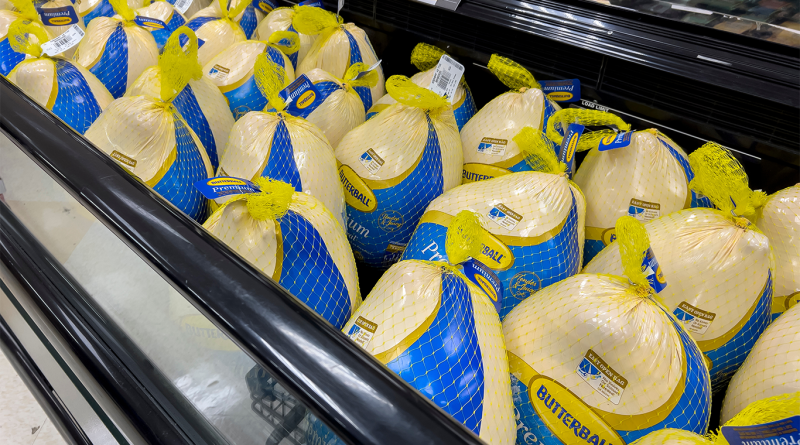
US shoppers should have no trouble finding a turkey this Thanksgiving. Production has bounced back from last year’s decline of more than 8%, and wholesale prices are running only slightly ahead of 2025 levels.
Wholesale whole turkeys averaged $1.80 per pound in late October, compared with $1.69 per pound in the same week last year, according to David Anderson, an economist with Texas A&M AgriLife Extension. Wholesale prices have been higher than in 2025 for much of the year, but the gap has narrowed as the holiday approaches.
The supply recovery explains why. The number of birds going to market is up about 3%, and heavier average weights lift total production by nearly 6%. “That tells me there are plenty of turkeys,” Anderson said.
Avian influenza has not gone away. A few highly pathogenic outbreaks have been reported in recent weeks, but Anderson said they are not enough to significantly affect holiday supplies.
Retail prices are up, but stores are competing for shoppers
Grocery shoppers will still pay more than last year. The national average retail price for frozen, conventionally produced whole turkeys was $1.26 per pound in early November, up from $1.03 a year earlier, according to USDA retail data cited by Anderson.
That figure tells only part of the story. Retail turkey prices are shaped by store promotions and contracts agreed months in advance, rather than by the wholesale spot market.
There are signs that promotional activity is building. USDA data shows more stores featuring turkeys than at this point last year, with about 2500 stores nationwide advertising frozen conventional whole birds. Anderson expects more features as Thanksgiving gets closer.
For producers, conditions have improved. Better demand, higher wholesale prices, and lower feed costs have put the industry in a stronger position than it was a year ago.
Demand patterns are shifting, though. Anderson noted that Thanksgiving demand for turkey has held up well, while demand for a second bird around Christmas has faded.
Bird flu remains a live risk outside the US
The comfortable US picture does not hold everywhere. In the UK, where turkey is a Christmas staple, a bird flu outbreak on a commercial free-range egg farm in Northumberland in late October led to the culling of the flock and renewed warnings about festive poultry supplies. Experts there said further cases were likely as migratory birds return, and that turkeys being reared for Christmas are vulnerable. Farming leaders said there was no evidence of wider disruption to festive food supplies so far, but that the coming weeks would be decisive.
Brazil, the world’s largest chicken meat exporter, is dealing with a different disease problem. In October, the country confirmed Newcastle disease on a turkey farm in the southern state of Santa Catarina. Under Brazil’s trade protocol with China, an outbreak triggers an automatic halt to poultry exports while Chinese authorities decide how far any restrictions should extend.
These cases show how quickly animal disease can move from a farm-level problem to a trade and retail issue. A single confirmed case can close export markets, tighten supplies in importing countries, and push up prices for processors and foodservice buyers who rely on imported poultry.
The next few weeks will decide how the season ends
For the US market, the main uncertainty is whether the current calm on avian influenza lasts through November. The fall migration of wild birds is when the risk of new cases tends to rise.
If supplies hold, the more interesting question is how aggressively retailers compete on price in the final stretch before Thanksgiving, and whether shoppers who face higher costs elsewhere in the grocery aisle see turkey as a bargain or a stretch.
Elsewhere, the picture is less settled. UK producers are entering their most important trading weeks with disease risk still high, and Brazil’s export position depends on how its trading partners respond to the Newcastle case.
The global poultry trade has learned to live with disease outbreaks. Whether this holiday season passes without a major disruption depends on how the next few weeks of migration play out.
Source
High Plains Journal