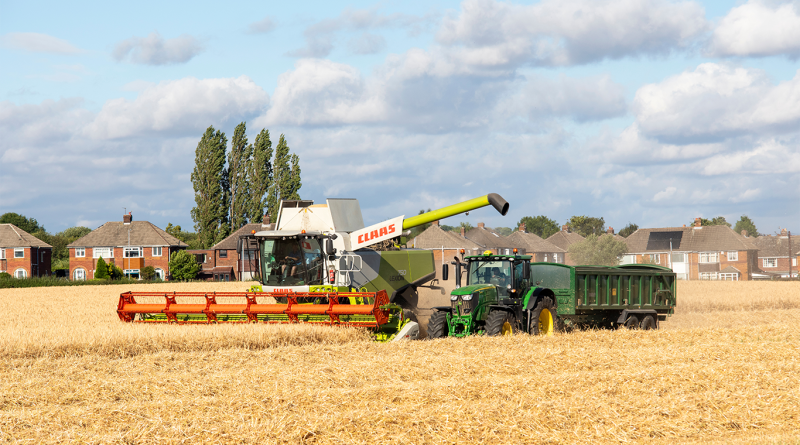
UK food resilience faces a tougher test as global risks rise
Subscribe to our free newsletter today to keep up to date with the latest food industry news.
Britain’s food supply chain has absorbed a remarkable sequence of disruptions in recent years, ranging from the latest pandemic and Russia’s invasion of Ukraine to extreme weather, inflation, labor constraints and upheaval in global shipping, yet the system’s ability to withstand a more severe national emergency remains largely untested.
That distinction is now attracting greater scrutiny after the National Audit Office warned that the Department for Environment, Food and Rural Affairs, or Defra, has not done enough in recent years to prepare the country for a catastrophic interruption to food supplies.
The problem is not evidence that Britain is about to run out of food, nor does the assessment suggest that international sourcing is inherently a weakness, because diversified trade can provide a valuable buffer when domestic production encounters difficulties. The more pressing concern for government and industry is whether commercial supply chains that have proved highly adaptive during familiar crises would remain functional during an event that simultaneously disrupted ports, energy supplies, communications networks, transport infrastructure and consumer demand.
For logistics businesses, retailers, food manufacturers and infrastructure operators, that changes the nature of the resilience debate, because continuity planning can no longer be treated solely as an internal question of inventory, supplier relationships and transportation capacity. Food is one of the UK’s 13 critical national infrastructure sectors, which means the resilience of warehouses, cold stores, ports, distribution centers, transport links and energy networks increasingly belongs within a wider discussion about national preparedness.
Britain’s food network combines diverse sourcing with concentrated infrastructure
The scale and complexity of the British food system make simple measures of self-sufficiency an unreliable guide to resilience, because domestic production and overseas trade perform different functions across thousands of products and supply chains.
Defra figures show that 58% of the food consumed in the UK during 2025 originated from domestic production when measured using the farm-gate value of raw food, while 23% came from the EU and a further 19% originated elsewhere in the world. Thirty-five countries accounted for 90% of imported food supply, suggesting that Britain has considerable geographical diversification at an aggregate level even though individual commodities can remain dependent on much narrower origins.
International sourcing has considerable strategic value because a food system supplied from several regions can compensate when poor harvests, disease or other disruptions affect one market, but diversification on paper does not eliminate physical bottlenecks once products begin moving through the logistics network.
Britain imported £67.8 billion of food, feed and drink in 2025, representing a 6% increase in current prices compared with 2024, while imports increased 5% after adjusting for trade price inflation. The Netherlands was the largest country of dispatch, accounting for £8.1 billion, or 11.9%, of the total, while the 10 largest countries of dispatch collectively accounted for 66.5% of imports.
A large share of imported food also moves through a limited number of major gateways, with Dover, Felixstowe, Southampton and London Gateway playing significant roles in the flow of products into the country. Dependence on major infrastructure is an unavoidable feature of efficient logistics, since consolidation produces economies of scale and allows businesses to move high volumes at lower cost, but the same concentration can create operational exposure when several failures occur at once.
The relevant question for supply chain executives is therefore less about whether Britain imports too much food and more about whether the physical network has sufficient alternatives when a key node becomes unavailable for an extended period. A business may have multiple suppliers in different countries yet remain vulnerable if those suppliers depend on the same port, warehouse, power network, road corridor or technology platform once their products arrive in Britain.
Commercial resilience has carried Britain through crises while national planning has lagged
Recent history gives food businesses legitimate reasons to be confident about their ability to respond to disruption, because retailers, wholesalers, manufacturers and logistics operators maintained the movement of goods through the exceptional pressures created by the pandemic and the economic effects of Russia’s invasion of Ukraine.
Those experiences demonstrated the capacity of commercial networks to reroute deliveries, modify product ranges, change sourcing strategies and make operational decisions at a speed that would be difficult to reproduce through centralized government planning. They also reinforced the argument that private-sector expertise should remain at the center of any national resilience strategy because businesses understand their infrastructure, suppliers, customers and constraints in far greater detail than government departments can reasonably replicate.
The NAO’s concern is that commercial competence may have encouraged too much confidence in a system whose performance under a catastrophic scenario has not been properly tested. Defra has recognized that the probability and severity of major disruptions are increasing, but the watchdog found that work intended to strengthen resilience across the food supply chain, households and communities remains at an early stage.
Communication between government and industry presents another concern because food companies told the NAO that Defra’s engagement had become less frequent since the pandemic, despite businesses having direct operational knowledge that could determine whether an emergency response works outside a planning document.
The most recent national exercise testing Defra’s preparedness for a catastrophic event that would severely disrupt food availability took place in 2023, and most food supply chain businesses did not participate. Local resilience forums have also reported uncertainty about what Defra would expect from them during a major disruption, exposing the possibility that national, regional and commercial response plans could operate from different assumptions at the moment coordination matters most.
That gap deserves attention because the next serious disruption may bear little resemblance to the last one. The pandemic created extraordinary demand shifts and labor problems, but much of Britain’s physical infrastructure remained available, whereas a compound emergency involving a prolonged power outage, cyberattack, extreme weather event or transport disruption could remove several forms of capacity simultaneously.
Cold stores and transport hubs are becoming strategic assets
The discussion becomes particularly important in temperature-controlled logistics, where the continuity of electricity supply can determine whether stored food remains commercially usable or becomes waste within a limited period.
Cold-storage operators and food logistics businesses have argued that warehouses and transport hubs deserve stronger treatment within critical infrastructure planning, particularly where that status would help protect energy supplies during widespread outages. The argument illustrates how food security increasingly intersects with infrastructure policy, because resilience depends not only on farms, factories and supermarkets but on the industrial facilities that connect them.
An extended electricity failure could affect refrigeration, warehouse management systems, communications, automated equipment and charging infrastructure while simultaneously disrupting production sites and retail operations. A cyber incident could generate a different chain of failures by disabling ordering systems, inventory visibility, transport planning or access to operational data even when physical infrastructure remained intact.
Building resilience against those events does not mean maintaining unlimited spare capacity, because redundancy carries costs that eventually reach businesses, government or consumers. Backup generation, alternative transport routes, additional inventory, duplicate systems and spare warehouse capacity all require capital, while highly efficient supply chains have spent decades removing unused assets and reducing inventory precisely because those resources are expensive.
The practical challenge is deciding where additional resilience provides sufficient value to justify the cost, which requires government and industry to develop a clearer understanding of the infrastructure whose failure would create consequences far beyond a single company.
Better mapping of critical food infrastructure would allow policymakers to identify concentrations that might otherwise remain hidden within privately operated networks, while realistic exercises involving businesses, local authorities and central government could expose incompatible assumptions before an emergency occurs.
Britain does not need to abandon the commercial efficiency that has allowed its food sector to manage recent disruptions, but previous success should not be treated as proof that the same system can absorb every foreseeable shock. The more useful lesson from the NAO assessment is that resilience depends on understanding where efficiency has created concentration, where commercial contingency plans depend on public infrastructure and where government planning depends on private capacity that has never been tested under catastrophic conditions.
For executives responsible for logistics, manufacturing, retail and food distribution, the next stage of resilience planning is likely to extend beyond conventional supplier diversification and business continuity procedures toward a more detailed examination of power, ports, cold storage, data systems, transport routes and public-sector coordination. Britain’s food supply chain has repeatedly demonstrated that it can adapt when disruption arrives, but its performance during a crisis outside recent experience will be determined by how thoroughly government and industry test those dependencies before they are forced to rely on them.
Source:
The Guardian
National Audit Office