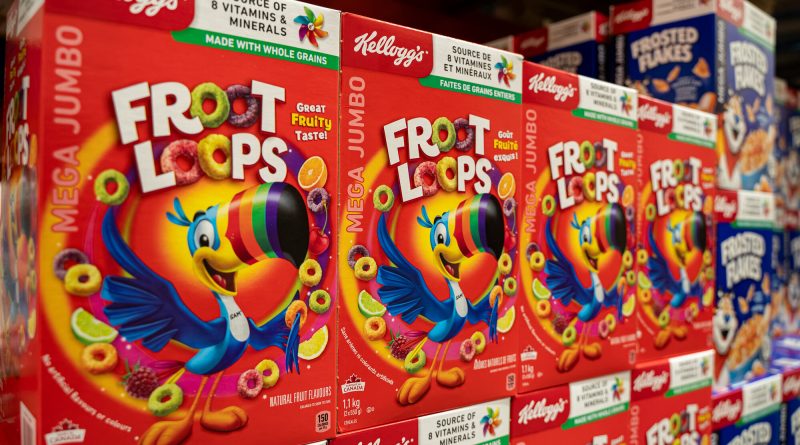
WK Kellogg to eliminate artificial food colors by end of 2026
Subscribe to our free newsletter today to keep up to date with the latest food industry news.
WK Kellogg is bringing forward its plan to eliminate artificial colors from its US cereal portfolio, setting the end of 2026 as its new deadline and placing some of the food industry’s most recognizable products at the center of a wider manufacturing transition.
The Battle Creek, Michigan-based cereal maker said production of reformulated products, including Froot Loops and Apple Jacks, will begin later this year, with shipments to retailers expected before year-end. Colors derived from fruit and vegetable juices and other plant-based ingredients will replace artificial alternatives across the portfolio.
The move comes one year ahead of WK Kellogg’s previous timetable. It reflects a shift taking place across the US packaged food sector as manufacturers respond to new retailer standards, government initiatives and changing customer expectations around certified synthetic colors.
For manufacturers, replacing a food color is rarely an isolated recipe adjustment. Color affects ingredient sourcing, processing conditions, production equipment, shelf-life performance and the appearance consumers associate with established brands. A product such as Froot Loops raises the difficulty further, since its red, orange, yellow, green, purple and blue pieces form part of a product identity developed over decades.
Kellogg’s color change reaches beyond the recipe
WK Kellogg says it has made a significant investment in its manufacturing facilities to support natural colors at scale. The company has not disclosed the value of that investment, but the need for plant changes points to the operational work hidden behind an apparently straightforward ingredient substitution.
Extensive consumer testing has formed another part of the project. WK Kellogg tested its recipes with the aim of retaining the established taste and six-color appearance of Froot Loops using colors from natural sources. The company is removing the preservative BHT from the small amount of cereal packaging where it remains in use. Foods supplied to schools have already been reformulated without artificial colors, and the business stopped launching new products containing those colors in January.
Such work illustrates one of the central difficulties facing large food producers. Synthetic colors offer manufacturers familiar processing characteristics and repeatable results. Moving to different sources can require teams to reassess how ingredients react to heat, moisture, storage and other production conditions.
Those variables become more pronounced at commercial scale. A formulation that succeeds during development must produce a consistent result when it moves onto manufacturing lines processing large volumes at speed.
Kraft Heinz has offered a glimpse of that workload through its own program to remove FD&C colors from its US portfolio by the end of 2027. As of June 2026, the company said more than 450 formulas were locked and progressing through trials, consumer testing and shelf-life validation.
Kraft Heinz said scaling a new formulation can introduce variables involving equipment interaction, ingredient handling and processing conditions. Its development process examines removal, replacement and wider product redesign depending on the role color plays in a particular product.
The scale of those programs means demand is spreading through the ingredient supply chain. Food manufacturers need alternatives that are technically suitable, available in sufficient quantities and capable of producing dependable results across different applications.
Regulators have been expanding the range of available options. In May 2025, the FDA approved three color additive petitions involving colors from natural sources. Galdieria extract blue was authorized for uses including breakfast cereal coatings, and the permitted use of butterfly pea flower extract was expanded to ready-to-eat cereals and several snack categories.
The additions give product developers more tools, but a larger ingredient palette does not remove the need to test cost, availability, processing performance and consumer acceptance.
Reformulation is becoming an industry-wide production program
WK Kellogg’s accelerated deadline sits alongside commitments from some of the country’s largest food producers.
General Mills pledged to remove certified colors from all US cereals by summer 2026 and from its full US retail portfolio by the end of 2027. When it announced the plan in June 2025, the company said 85% of its US retail portfolio was already manufactured without certified colors. Its K-12 school foods reached that target by March 2026.
Retailers are applying pressure from the other end of the supply chain. Target said its entire cereal assortment would be made without certified synthetic colors by the end of May 2026. Walmart has set January 2027 as the deadline for eliminating synthetic dyes from its US private-brand food products, alongside more than 30 other ingredients covered by its reformulation program.
Federal policy is moving in the same direction. The FDA and Department of Health and Human Services announced an initiative in April 2025 aimed at moving the food industry away from petroleum-based synthetic dyes. The program covers six certified colors frequently used in the US food supply and is paired with work to authorize alternatives from natural sources.
Consumer pressure has added another factor. AP reported that protesters delivered petitions carrying 400,000 signatures to Kellogg’s headquarters in 2024 calling for the removal of artificial dyes and BHT. The company later reached an agreement with Texas Attorney General Ken Paxton covering removal of the dyes by the end of 2027, a timetable its latest announcement now brings forward.
Taken together, these commitments are turning color reformulation into a coordinated industry program spanning R&D, procurement, production, quality assurance and retail.
For ingredient suppliers, growing demand for colors from natural sources creates an opportunity tied directly to the reformulation cycle. For food producers, it creates a more complicated calculation. A replacement ingredient must work in the factory, remain available at commercial volumes and deliver a product close enough to the original that shoppers still recognize it.
WK Kellogg’s colorful cereals make that challenge unusually visible. Consumers will see a different ingredient list, but manufacturers will see the work behind it: new formulations, new inputs, plant investment, validation and tightly managed production changes.
As artificial colors disappear from more US products, the competitive question is shifting toward execution. The manufacturers that can reproduce familiar colors reliably at industrial scale, without sacrificing product performance or availability, will determine how smoothly the next stage of food reformulation reaches supermarket shelves.
Source